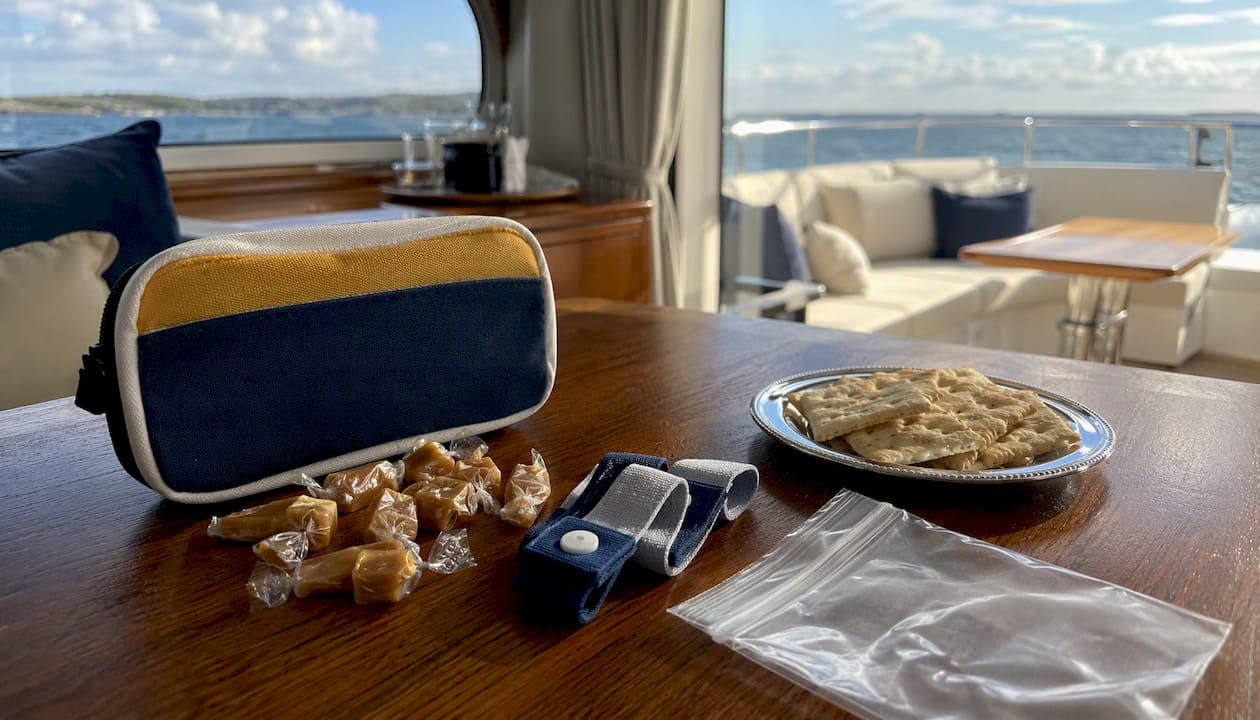
Start with non-drug steps first: seat your child midship, keep fresh air moving, have them fix their gaze on the horizon, offer a light snack, and try Sea-Bands or ginger before reaching for any medication. When those measures aren't enough, age-appropriate OTC antihistamines like dimenhydrinate (Dramamine) are a reasonable next step — but only after a test dose at home and, for children under two, not at all.
The CDC Yellow Book recommends behavioral countermeasures as the first line of defense, with medications reserved for cases where those steps fall short. Here's what to do before you leave the dock:
- Seat your child at the lowest, most central point of the vessel
- Have them face forward and keep their eyes on a fixed horizon point
- Turn off screens and put books away
- Offer a small, low-fat snack before boarding
- Slip on a pair of Sea-Bands (acupressure wristbands) as a low-risk first try
- Give any OTC antihistamine at least one hour before departure, and only after a prior test dose at home
Key Takeaways
Effective seasickness prevention for children combines behavioral preparation, low-risk natural options, and age-appropriate medication used in the right order, with crew communication as the most underused tool of all.
| Point | Details |
|---|---|
| Behavioral steps come first | Midship seating, horizon gaze, fresh air, and no screens reduce symptoms before any medication is needed. |
| Test-dose OTC meds at home | Dimenhydrinate and diphenhydramine can cause paradoxical agitation; test before the trip, not on it. |
| Under-two rule is absolute | No antihistamines for children under two years old; consult a pediatrician for this age group. |
| Ginger and Sea-Bands are low-risk | Evidence is limited but side effects are minimal; worth including in the kit as a first-line natural option. |
| Brief the crew before boarding | A captain who knows a child's susceptibility can adjust speed, routing, and activity timing from the start. |
Table of Contents
- What to plan and pack before your child's boat trip
- Non-drug steps that genuinely help on board
- What medications are safe, and what are the U.S. dosing basics?
- What to do if your child starts feeling seasick
- Captain and crew tips from Exoticacharters for managing seasickness on yachts
- Why prevention matters more on a private yacht than anywhere else
- Sources
What to plan and pack before your child's boat trip
Good seasickness prevention for children starts well before you reach the marina. A little preparation the night before can make the difference between a child who thrives on deck and one who spends the trip below.
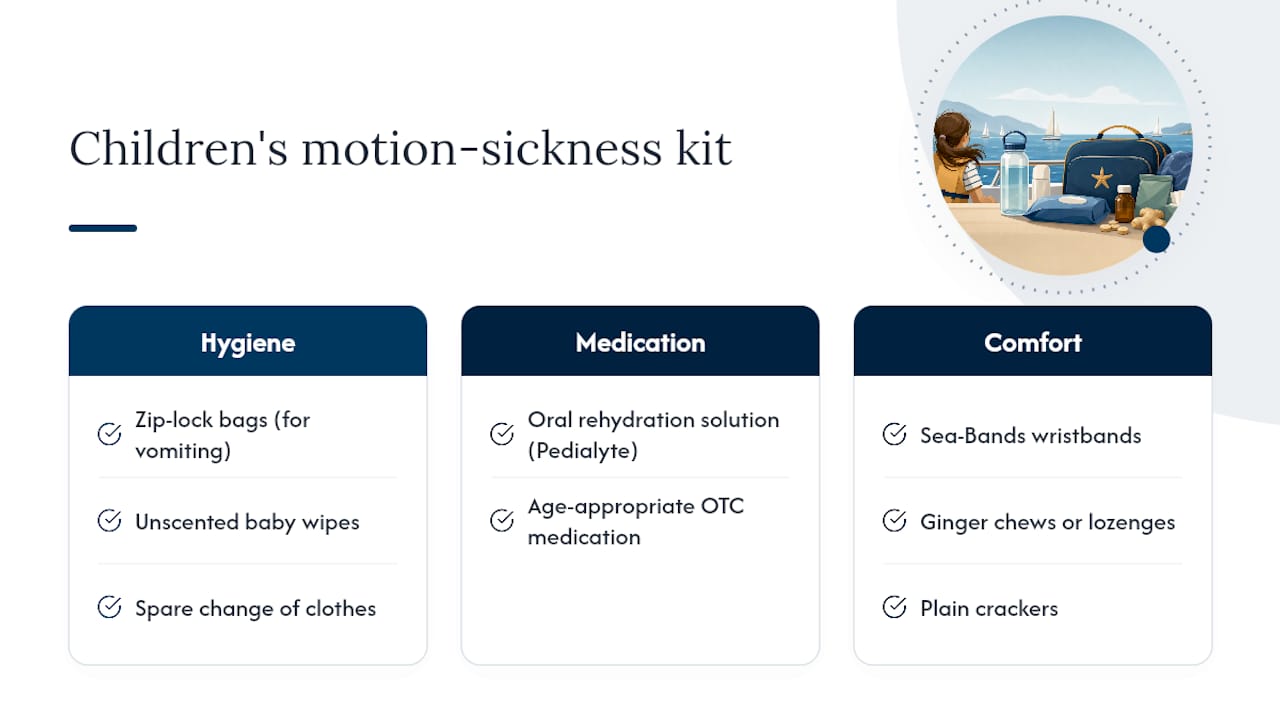
Pack a dedicated motion-sickness kit. A small zip pouch works perfectly. Include: zip-lock bags (for vomiting), unscented baby wipes, a spare change of clothes, an oral rehydration solution such as Pedialyte, age-appropriate OTC medication, a pair of Sea-Bands, ginger chews or lozenges, and a few plain crackers. For a fuller family packing list, the Exoticacharters family packing guide covers everything from medications to clothing layers.
Test-dose any antihistamine at home first. A small number of children respond to dimenhydrinate or diphenhydramine with paradoxical agitation rather than the expected drowsiness. Giving a test dose two to three days before the trip lets you catch that reaction in a safe, familiar environment rather than mid-passage.
Arrange logistics in advance. When booking, request a midship cabin or seating area. Contact the captain or crew ahead of time to flag any child who has a history of motion sickness; experienced crews can adjust activity scheduling and keep a calm, shaded spot ready. Plan departure times around your child's nap schedule when possible — a rested child handles motion far better than a tired one.
Pro Tip: Pack the motion-sickness kit in a brightly colored pouch and tell the crew exactly where it's stowed. In a busy moment, you don't want to be searching three bags for a zip-lock.
Non-drug steps that genuinely help on board
Behavioral measures are not a consolation prize while you wait for medication to kick in. Used consistently, they reduce the sensory mismatch that triggers motion sickness in the first place.
The inner ear detects movement, but the eyes — fixed on a stationary cabin wall or a screen — report stillness. That conflict is what makes children feel ill. Resolving it is the goal of every behavioral step below.
- Move to midship and stay low. The center of a vessel experiences the least pitch and roll. On a sailboat, the cockpit is usually the best spot; on a motor yacht, a low-deck seating area near the beam. See Exoticacharters' boat stability guidance for vessel-specific advice.
- Fix eyes on the horizon. Kaiser Permanente's pediatric care guidelines list horizon focus as one of the most effective immediate measures. Encourage your child to pick a point on the water line and hold it.
- Keep air moving. Fresh, cool air reduces nausea intensity. Open a hatch, position a fan, or move the child to an open deck area.
- No screens, no books. Reading or watching a screen while the body is in motion dramatically worsens the sensory conflict. Swap devices for conversation, simple card games, or cloud-spotting.
- Light snacks, small sips. An empty stomach worsens nausea; a heavy one does too. Plain crackers, a banana, or dry cereal eaten 30 minutes before departure hits the right balance.
- Keep the head still. Encourage your child to rest their head against a seat back rather than letting it move freely with the vessel's motion.
Ginger and Sea-Bands: worth trying, with realistic expectations
Arnold Palmer Hospital for Children notes that ginger has the strongest research base among natural remedies, with most studies using moderate amounts. It's well tolerated and generally has fewer side effects than antihistamines. Ginger chews, lozenges, or flat ginger ale are practical formats for children.
Sea-Bands apply pressure to the P6 (Nei-Kuan) acupressure point, roughly one centimeter above the wrist crease. Laboratory trials show they perform no better than placebo in controlled settings, yet many parents and children report real relief. The risk is essentially zero, so they're worth including in the kit. Place the button firmly on the correct point — a band worn loosely or in the wrong position won't deliver even the placebo benefit.
Habituation is the most durable long-term solution. Gradual, repeated exposure to boat motion over several trips tends to reduce a child's sensitivity. Short, sheltered outings on calm water are a good starting point; toddler-friendly boat trips in protected bays are ideal for very young children building their sea legs.
Pro Tip: For children who are nervous about the boat itself, a brief pre-boarding walk around the vessel with a crew member can reduce anxiety — and anxious children feel motion sickness more acutely.
What medications are safe, and what are the U.S. dosing basics?
When behavioral measures aren't enough, OTC antihistamines are the most commonly used option for preventing motion sickness in children. WebMD's pediatric guidance notes that antihistamines can be effective but cause drowsiness and require careful attention to age-appropriateness and dosing.
Dimenhydrinate (Dramamine Classic) is the most widely referenced option for children. Seattle Children's provides age-based dosing: the children's chewable tablet comes in 25 mg and 12.5 mg formulations. Do not use in children under two years old. Give the dose some time before travel.
Diphenhydramine (Benadryl) works similarly and is available in liquid form, which makes dosing easier for younger children. The same under-two restriction applies, and drowsiness is a consistent side effect.
Meclizine is generally not recommended for children under 12. Scopolamine patches are typically avoided in young children due to the risk of significant adverse effects, including confusion and agitation.
| Medication | Minimum age | Typical form | Timing before travel | Main side effect |
|---|---|---|---|---|
| Dimenhydrinate (Dramamine) | 2 years | Chewable tablet (12.5 mg or 25 mg) | 1 hour | Drowsiness |
| Diphenhydramine (Benadryl) | 2 years | Liquid or tablet | 1 hour | Drowsiness |
| Meclizine | 12 years | Tablet | 1 hour | Drowsiness |
| Scopolamine patch | Generally avoided in children | Patch | Night before | Agitation, confusion |
- Always perform a test dose at home before the trip to check for paradoxical agitation.
- Never give antihistamines to children under two years old.
- Consult your pediatrician before using any of these medications in children with asthma, glaucoma, or urinary conditions.
- Repeat dosing on multi-day passages should follow package instructions; do not exceed the labeled daily dose.
What to do if your child starts feeling seasick
Act quickly. The sooner you intervene, the easier it is to reduce symptoms before they escalate.
- Move your child to midship and as low as possible on the vessel.
- Get them into fresh air immediately.
- Have them sit or lie down, with their head resting still against a surface.
- Encourage slow, steady gaze at the horizon.
- Offer small sips of water or a clear electrolyte drink — not juice, not soda.
- Plain crackers can help settle the stomach if the child can tolerate them.
Prepare for vomiting calmly. Seattle Children's notes that children with motion sickness usually don't vomit more than once. Have a zip-lock bag ready, followed by wipes and a change of clothes. After vomiting, most children feel noticeably better within minutes.
Watch for these signs that require medical attention:
- Vomiting that continues for more than a few hours with signs of dehydration (dry mouth, no tears, no urination)
- Altered mental status or unusual confusion
- Symptoms that persist more than 48–72 hours after the trip ends
- Inability to keep any fluids down despite rest and calm conditions
For most short passages, motion sickness resolves quickly once the vessel reaches calmer water or the child is moved to a stable position. Keep Kids Healthy notes that most children do fine on large, stable vessels; it's the longer offshore passages and rough conditions that raise the real risk.
Captain and crew tips from Exoticacharters for managing seasickness on yachts
Years of experience placing families aboard sailing yachts, motor yachts, and catamarans in destinations from French Polynesia to Alaska have taught us a few things that don't appear in medical guides.
On a sailboat, the cockpit is almost always the best position for a child prone to motion sickness. It sits at the vessel's center of gravity, offers an unobstructed view of the horizon, and keeps the child in fresh air. Avoid positioning children in the bow cabin or forward berths, where pitch motion is most pronounced. For sailboat charter options, we can advise on which hull configurations offer the most stable ride for families.
On a motor yacht, the main salon at water level is preferable to upper-deck seating when conditions are choppy. The upper bridge deck offers a better view but amplifies roll.
Crew actions that make a real difference: scheduling active excursions (snorkeling, kayaking) during morning calms rather than afternoon chop; keeping the main deck shaded and breezy; conducting a short pre-boarding orientation for children so the vessel feels familiar before it moves; and knowing exactly where the motion-sickness kit is stowed for quick access.
Pro Tip: Ask your captain to schedule the longest open-water crossings overnight when children are asleep. Many families on expedition charters find that kids sleep through passages that would otherwise be uncomfortable.
Why prevention matters more on a private yacht than anywhere else
A private crewed yacht charter is one of the most extraordinary ways to show children the natural world — remote anchorages, wildlife encounters, and days shaped entirely around the family's pace. Seasickness doesn't just cause discomfort; it can derail an entire itinerary and leave a child with an anxious association with the water that takes years to undo.
Prevention is not about eliminating all risk. It's about giving children the best possible chance to be present for the experience. From our perspective, the combination of behavioral preparation, a well-stocked kit, and a crew that's been briefed in advance covers the vast majority of cases. Medications are a useful backstop, not the primary plan.
Before you board, tell the captain. That single conversation — flagging a child's susceptibility, asking about the day's sea state, and confirming where to seat them — is worth more than any single remedy in the kit. The crew on a fully crewed charter exists precisely to make that kind of coordination seamless, and experienced captains take it seriously.

Planning a family charter and want to discuss the itinerary, sea conditions, and how the crew can support younger guests? Explore luxury yacht options with Exoticacharters and speak with a charter specialist who has been on the water.
Sources
The sources below are the primary references used for dosing guidance, behavioral measures, and safety limits in this article.
- Motion sickness | CDC Yellow Book™
- Motion sickness - Seattle Children's
- Motion sickness in children — Kaiser Permanente
- Does your child get motion sickness? Here’s how to help. - Orlando Health Arnold Palmer Hospital for Children
- Are motion sickness meds safe for children? - WebMD
- Helping Kids Avoid Sea Sickness on a Cruise - Keep Kids Healthy
This article provides general information only and is not a substitute for professional medical advice. Consult your child's pediatrician before starting any medication, particularly for children with underlying health conditions or those under two years of age.