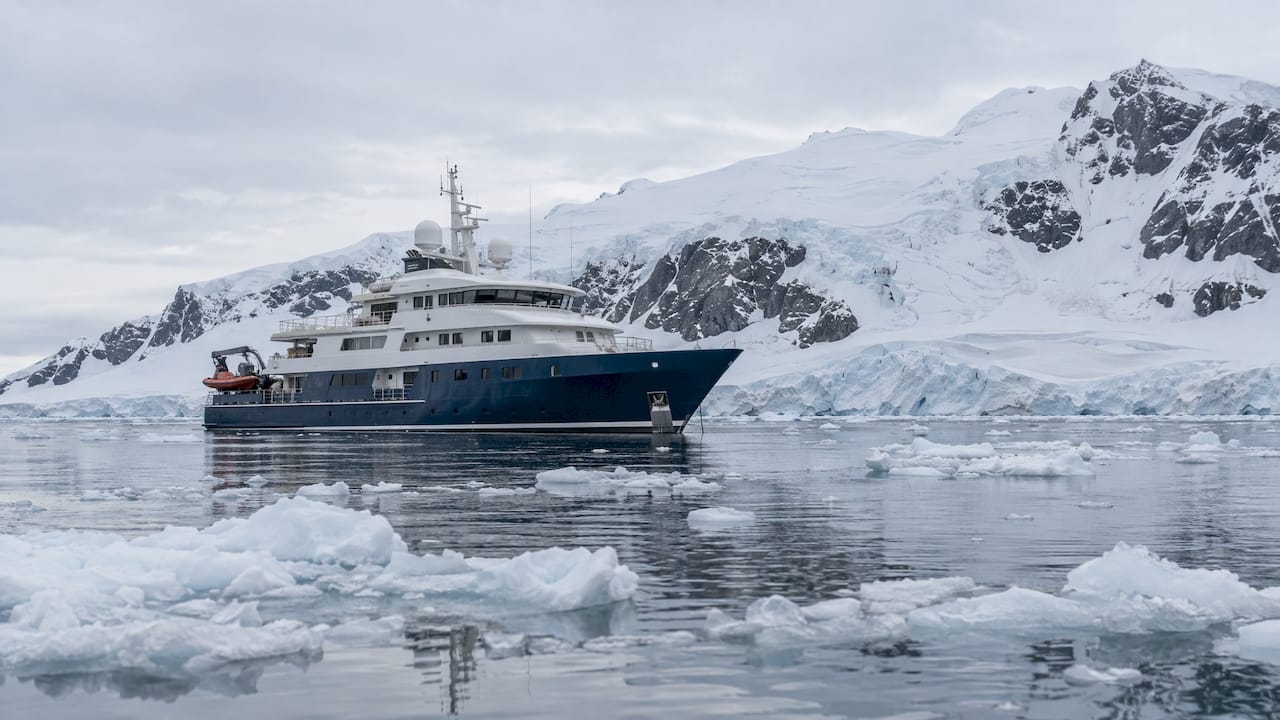
An expedition yacht charter is a private, fully crewed voyage built around a place rather than a port: the Galápagos, Antarctica, French Polynesia, Alaska. The yacht is chosen for the water you want to reach, the crew for what you want to do there, and the route is written around your group, not a published departure date. Getting those three choices right is the whole job, and it is easiest with people who have run vessels and dive programs themselves. At Exotica Charters, our team is made up of former captains and water sports professionals, and that is the lens for everything below.
TL;DR
- An expedition charter is a private yacht, crew and itinerary built around a remote destination, with diving, wildlife and adventure as the plan rather than the extras.
- The vessel matters more than the décor: range, construction, redundant systems and global communications decide how far and how safely you can go.
- Destination and season come first. Weather, ice and park rules shape the route, so build in flexibility.
- Private expedition charters cost far more than a cabin on a scheduled expedition cruise, and the price buys control of the schedule, the group and the guides.
- Plan with specialists who have captained and dived these waters, and start with where you want to be, not which boat you like.
Table of Contents
- What an expedition yacht charter actually is
- What makes a yacht expedition-capable
- Choosing your destination and season
- What each kind of traveler should ask for
- Crew, safety and what to expect on board
- What an expedition charter costs
- How to plan the voyage, step by step
- Our perspective
- Plan your expedition charter with Exotica Charters
- FAQ
- Sources
What an expedition yacht charter actually is
A standard yacht charter is usually a coastal holiday: marinas, beach clubs, a few islands a day. An expedition charter swaps that for remote anchorages, long passages and days organized around wildlife, reefs or landscapes. Think of black-sand beaches in Antarctica, a drift dive in a Pacific pass, or sea lions on a Galápagos shore.
It also differs from an expedition cruise. According to The Roam Report's coverage of U.S. travel trends, expedition cruises are small-ship journeys built around exploration, and what sets them apart from luxury voyages is the onboard experts: naturalists, biologists, historians and photographers who lead excursions. A charter keeps that idea and removes the shared departure. You are the only guests aboard, so the captain can hold an anchorage for an extra day when the whales are close, and you can bring your own divers, children or naturalist guide.
Demand for this style of travel is rising. The same Roam Report piece, drawing on Internova Travel Group's 2025 North American Travel Insights, notes that over 80% of luxury and ultra-luxury travelers were interested in luxury yacht cruising and nearly two-thirds in expedition cruises, while expedition cruise prices rose more than 20% between 2023 and 2025.

What makes a yacht expedition-capable
A beautiful yacht is not automatically one that can spend a week far from a harbor. For remote cruising, look at what the vessel can do before you look at the salon.
- Range. Remote passages mean long distances between fuel stops. Guidance for expedition cruising suggests a range of 3,000 nautical miles or more, and more for South Pacific or high-latitude work, as laid out in the IAATO yachting guidelines for Antarctic voyages, which stress self-sufficiency in fuel, spares and provisions.
- Construction. The same guidelines advise sturdy alloy or steel construction for polar waters. Ice and floating debris are not a place for a light hull.
- Redundancy. Twin engines, backup generation and manual overrides mean one failure does not end the trip.
- Communications and safety gear. Long-range communications, a 406 EPIRB (an emergency beacon that signals your position to rescue services), safety equipment for at least 100% of those aboard, and several shore-landing craft are all on the IAATO list.
- Tenders and toys. For divers and families, the practical question is how guests actually get ashore or into the water: tenders, dive compressors, kayaks and paddleboards.
We go through these differences in more detail in our guide to expedition yacht features. The short version: the right vessel is the one built for your destination, and it is not always the largest.
Matching the hull to the water
The five vessel types we charter each suit a different kind of trip:
| Vessel type | Best for | Typical strength |
|---|---|---|
| Expedition vessels and motor yachts | Polar waters, long ocean passages, remote dive sites | Range, strong construction, space for gear and guides |
| Luxury yachts | Large groups and multi-generational families | Cabins, deck space, a full crew and onboard amenities |
| Sailboats | Couples and sailing enthusiasts | Quiet passages and a close connection to the sea |
| Catamarans | Families and snorkelers in sheltered, shallow areas | Stability, shallow draft, wide decks |
| Yachts over 200 ft | Large parties wanting every amenity | Scale and onboard facilities |
If you are still deciding between these, our overview of yacht charter types explains which style fits which trip.
Choosing your destination and season
Destination decides almost everything else: the vessel, the crew, the season and the budget. Start here.
Galápagos: wildlife at arm's length
Galápagos cruises run year-round. According to the Cruise Lines International Association's expedition guide, January to May is hotter and potentially rainier, while June to December is drier and cooler. Which is better depends on what you want to see: warm water for snorkeling and swimming, or the cooler season with different wildlife activity. Our pages on the best time to charter a crewed yacht in the Galápagos and on wet season versus dry season walk through the trade-offs, and the breeding season versus dive season page is the one for divers.
The archipelago is a national park, so the route sits within park rules rather than being improvised day to day. A specialist who knows how those itineraries are built saves you from planning a trip that cannot be done.
Antarctica and the polar regions
Polar voyages are the purest form of expedition charter, and the most demanding. All Antarctica-bound yacht expeditions must be authorized by the operator's own country or the vessel's flag state, according to IAATO's information for yachts, and heavy fines can follow unauthorized visits. That authorization is part of the process for any legitimate voyage, not a hurdle to work around.
On the water, the rules shape your behavior ashore too. Guests are expected to follow return-to-ship signals and to clean boots and clothing before and after landings to support IAATO biosecurity. You can read what a crewed polar trip involves in our pages on Antarctica yacht charters and what a crewed Antarctica charter includes, and in our guide to private polar expeditions.
French Polynesia, Alaska and beyond
We also plan trips to French Polynesia, Alaska and other remote regions. The pattern is consistent: the destination sets the season, the season sets the vessel, and the vessel sets how far you can go. Warm-water Pacific atolls call for a different boat from the fjords of southeast Alaska.
What each kind of traveler should ask for
The same yacht can serve very different trips. Here is what we would build in for each.

Divers. Ask about the dive support on board: compressor capacity, tender size, and whether dive professionals travel with you. Our team includes water sports professionals, so we plan dive days around conditions and your certification level, not a fixed schedule.
Nature enthusiasts. The experience depends on the guides. The Roam Report highlights naturalists, biologists and photographers as what distinguishes expedition travel. On a private charter, you can plan for those specialists to join you and decide how much time each landing deserves.
Families. Look for stable platforms, shallow-water access and age-appropriate activities: snorkeling, paddleboarding, wildlife spotting. Catamarans are often a natural fit for younger children, while larger vessels give teens and grandparents more room.
Couples. Quiet anchorages, a smaller crew footprint and an itinerary with unhurried days. A sailing yacht or a smaller motor yacht often feels most private.
Luxury travelers. Comfort is expected, but the real luxury of a charter is control: your schedule, your menu and your route, with a crew that anticipates both.
Crew, safety and what to expect on board
On a remote voyage the crew is the safety system. National Geographic Expeditions' guidance on choosing an Antarctic travel company names the experience of the captain, staff and crew, the onboard technology, and lifesaving protocols and equipment as baseline safety components.
Expect a safety briefing before you leave port. Intrepid Travel's Antarctica guide notes that emergency briefings and lifeboat drills are mandatory under international maritime law, and that guests should be told about lifeboat, life-vest and evacuation procedures. Life jackets are worn for tender operations, and in polar regions guests do not walk ashore alone.
Who is actually on board? A typical expedition crew includes a captain, mates, engineers, a chef and stewards, plus specialist guides depending on the trip. We explain the roles in what crew is on board an expedition charter.
If anyone in your group has a medical condition, talk to your doctor before booking a trip far from hospitals, and make sure your travel insurance covers remote areas and medical evacuation.
What an expedition charter costs
Prices vary enormously by vessel, region and length, and we only quote a charter once we know the yacht, route and dates. For context, Business Insider reported in 2023 that one expedition charter specialist's week-long charters generally ranged from about $225,000 to several million dollars, with most clients spending 7 to 12 days aboard, versus $15,000 to $60,000 per person for scheduled expedition cruise trips. Those figures describe the top of the market, and a wide range of vessels sits below it.
What the higher price buys is the whole vessel, your own guest list and a route that bends to your wishes. Beyond the base charter fee, plan for the usual extras on a crewed yacht: fuel, food and drink, port fees and crew gratuities. Ask for these to be spelled out in your proposal so there are no surprises.
How to plan the voyage, step by step
- Start with the experience. Decide what matters most: diving, wildlife, a family adventure or a romantic escape. This narrows the destination quickly.
- Pick the season. Each region has a window, and the season changes what you see. Book early for peak months, because the number of suitable vessels in any remote area is limited.
- Set your group and length. Seven to twelve days is common for expedition charters. Remote destinations need travel days at each end, so allow for them.
- Match the vessel. Range, construction, tenders and cabin layout should fit the route and the group, as described above.
- Build the itinerary. Good itineraries leave room for weather and wildlife. CLIA advises that expedition itineraries depend on weather, ice and landing conditions, so travelers should be flexible. Our notes on itinerary planning for luxury charters show how we balance structure with freedom.
- Confirm the details. Crew, guides, activities, permits and insurance should all be settled in writing before you pay.
Our perspective
Most people start a remote charter by browsing yachts. We would start with the water. The best week we can build for you is the one where the vessel, the crew and the season all point at the same place.
Our team comes from the helm and the dive deck: former captains and water sports professionals. That matters on an expedition, because the questions that make or break a trip are practical ones. Where will the swell be on day four? Is the dive site workable at this tide? Is this the right tender for a family with young children? We ask those questions before you ever see a proposal.
That is why we plan trips around immersive experiences (diving, wildlife and adventure on the water) and why we offer motor yachts, luxury yachts, sailboats, catamarans and expedition vessels. We would suggest you tell us the place you dream of first, and let us show you the vessel that gets you there comfortably.
Mo
Plan your expedition charter with Exotica Charters
We plan fully crewed yacht charters to remote destinations such as the Galápagos, French Polynesia and Alaska, with itineraries tailored around diving, wildlife exploration and adventure on the water. Our clients rate us highly on Trustpilot.
Tell us where you want to go, who is coming and what you hope to see, and we will propose vessels and routes to match. Browse our remote luxury yacht charters or speak to a yacht charter specialist about your dates.
FAQ
How is an expedition yacht charter different from an expedition cruise?
An expedition cruise is a scheduled small-ship voyage with a shared guest list. An expedition yacht charter is a private vessel, crew and itinerary for your group alone. You decide the pace, the activities and who comes aboard, so a day can be extended when the wildlife or the diving is exceptional.
How long should an expedition charter be?
Seven to twelve days is the most common range, according to Business Insider's reporting. Remote regions like Antarctica or the Galápagos need travel time on either side, so allow extra days for flights and connections.
When is the best time to charter in the Galápagos?
Cruises run year-round. January to May is hotter and potentially rainier, and June to December is drier and cooler, per the CLIA expedition guide. The right month depends on whether you prioritize warm water, wildlife behavior or diving.
Can families do an expedition charter?
Yes. Stable vessels such as catamarans, shallow-water activities and a crew that knows how to run them suit children well. Tell us the ages of your group when you inquire so we can plan activities and cabin layouts accordingly.
What should I look for in an expedition yacht?
Look for long range, steel or aluminum construction, redundant systems, global communications, and enough tenders for your landings, as in the IAATO yachting guidelines. Then match those capabilities to your destination.
Sources
- The Roam Report: U.S. travelers trade mega cruise ships for boutique voyages
- IAATO yachting guidelines
- IAATO information for yachts
- CLIA expedition guide, 2024
- Business Insider: wealthy chartering yachts for extreme destinations
- National Geographic Expeditions: choosing an Antarctic travel company
- Intrepid Travel: Antarctica travellers guide