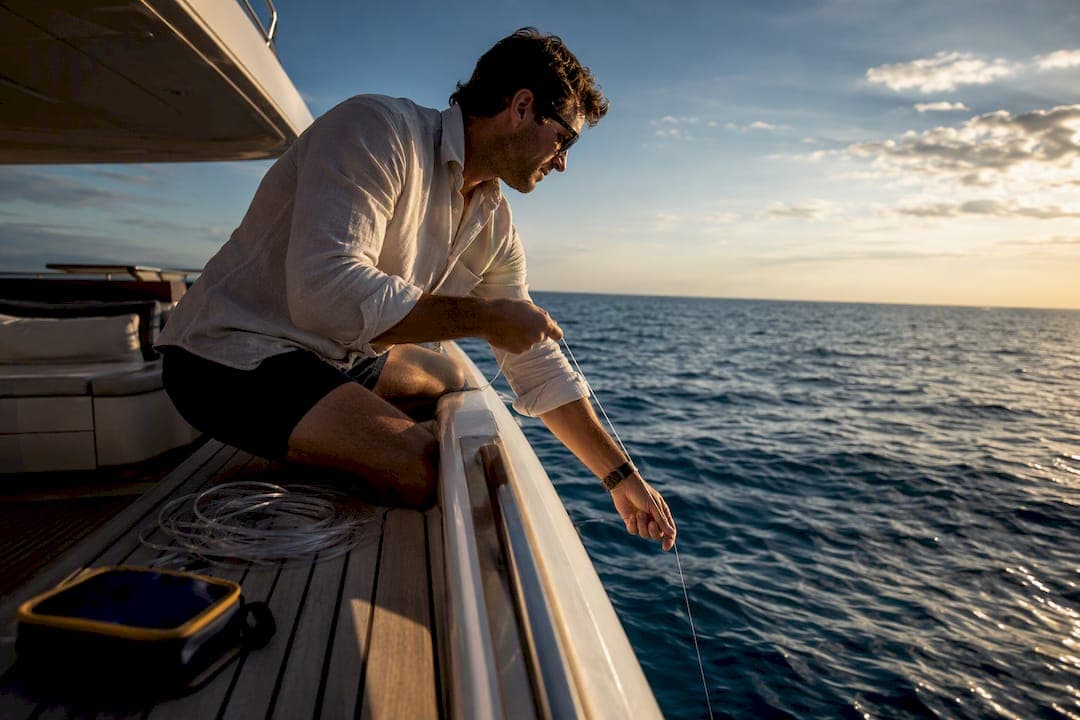
Yes, you can fish from a yacht, and it works better than most guests expect. The three approaches worth learning are trolling while underway, jigging while drifting over structure, and fishing at anchor for a reliable dinner catch. Always clear it with the captain first and check local marine park rules before a line goes in the water.
TL;DR:
- Always clear fishing plans with the captain and verify local regulations, especially in marine parks and no-take zones, to avoid penalties and health risks.
- Use a compact travel rod, a small reel with 30 to 80 pound line, and a few versatile lures suited for casual yacht fishing situations.
- Trolling works best during passages at 2 to 3 knots, jigging is effective near structure while drifting, and fishing at anchor is the most reliable for dinner catches.
- Keep fish on ice immediately after capture, bleed properly, and store fillets individually to preserve quality and prevent spoilage.
- Maritime environment protection requires that anglers dispose of scraps responsibly, avoid overfishing, and respect marine protected areas for sustainability.
Table of Contents
- Fishing From a Yacht: The Pre-Departure Checklist
- When to Troll, Jig, or Fish at Anchor
- Gear That Fits a Yacht's Limited Storage
- Setting Up Rods and Lines Without Risking the Boat
- From Rigged Line to Fish on Deck: The Sequence That Works
- What You Can Actually Expect to Catch
- Handling and Preparing Your Catch Onboard
- Choosing Fishing Spots That Match Your Yacht
- Keeping Your Catch Fresh Until Dinner
- Fishing Responsibly Around Reefs and Open Water
- How Charter Crews Handle Guest Fishing
- Ready to Fish on Your Next Charter?
- Sources
Fishing From a Yacht: The Pre-Departure Checklist
A little preparation on the dock saves a lot of frustration at sea. Before anyone rigs a rod, get a clear yes from the captain or crew, since some destinations enforce strict no-fishing zones and marina fishing is almost universally prohibited regardless of where you're berthed.
Marine parks and no-take zones carry real penalties in many regions, and ciguatera risk varies by location, so a quick conversation with the crew about local advisories is worth the two minutes it takes.
Pack light. A yacht is not a sport-fishing boat, and the gear should reflect that:
- A travel or short spinning rod (six to seven feet packs easily in a cabin locker)
- A small spinning reel loaded with 30 to 80 pound line, depending on target species
- A handful of leaders in varying strengths
- Three to six versatile lures (skirted trolling lures, jigs, and a couple of soft plastics cover most situations)
- Pliers, gloves, and a sharp fillet knife
- A small cooler or insulated bag for the catch
Think through where you'll actually fish from, how rods will be secured underway, and where the cleaning will happen before the first fish comes aboard. Crews appreciate guests who've already thought about the mess.
When to Troll, Jig, or Fish at Anchor
Each method suits a different moment in the trip, and knowing which to reach for saves wasted time and tangled lines.
- Trolling underway works best during passages, when the yacht is already moving and you want an opportunistic shot at pelagics like tuna or mackerel. Two to several knots is the effective range. Faster than that, and the lure skips unnaturally across the surface instead of swimming; slower, and it sinks and fouls in the prop wash. Stay well behind the boat's wake, since turbulence spooks fish and tangles lines closer in.
- Jigging while drifting rewards a bit of homework. Cut the engine near a reef edge, wreck, or drop-off, then work the jig vertically with sharp upward strokes and a controlled fall. The strike almost always comes on the drop, not the lift, so watch your line for slack rather than tension.
- Fishing at anchor is, according to experienced charter sailors, often the most reliable choice for guest comfort, since the boat sits still, the rig is simple, and a bottom bait over the right seabed produces dinner more consistently than a hopeful troll on passage.
Reading the water matters as much as picking a method. Diving birds and surface bait balls signal active feeding pelagics worth a trolling pass. A visible reef edge, color change in the water, or a sharp temperature break on the chart plotter usually marks structure worth a jig. None of this requires expertise, just a habit of looking up from the rod tip occasionally.
Gear That Fits a Yacht's Limited Storage
A yacht rewards compact, purpose-built gear over a garage full of sport-fishing tackle. A travel rod or compact spinning combo covers most casual scenarios and stows in a locker without a fight. Handline or yo-yo reels are worth carrying as a backup, particularly for jigging over structure, since they take up almost no space and work well when a rod holder isn't available.
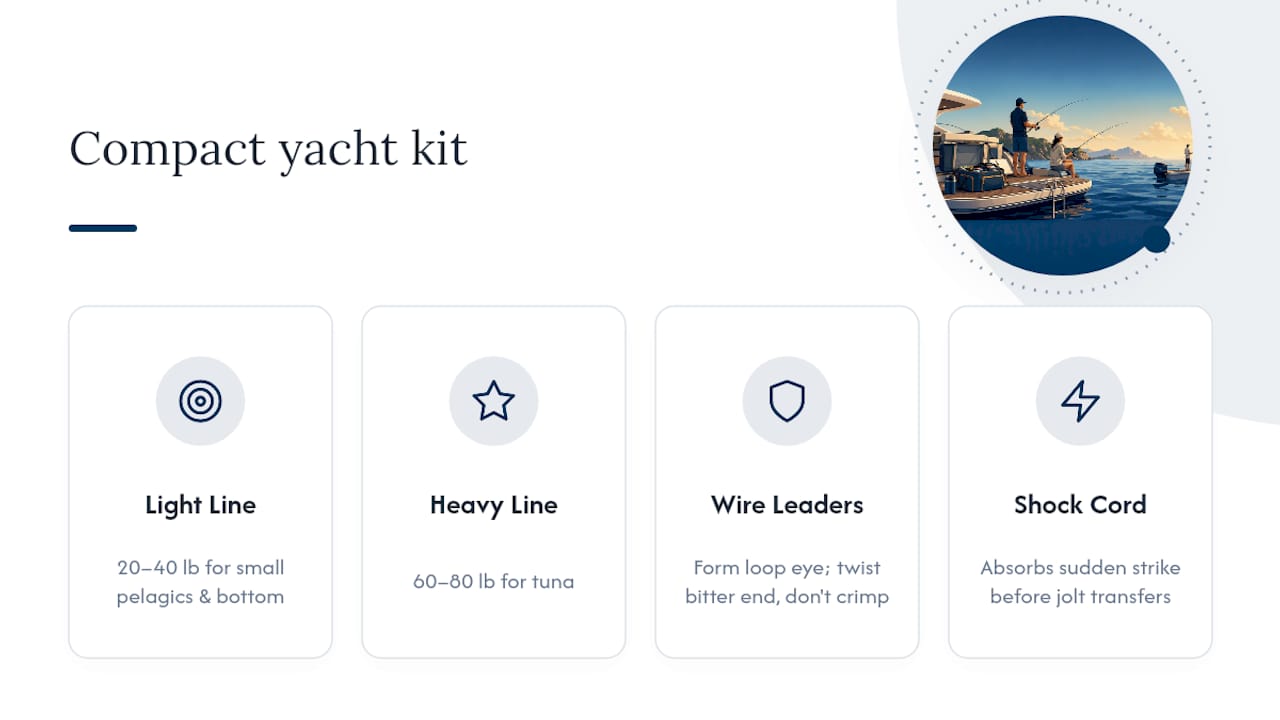
Line and rigging choices depend on target size. A general-purpose setup runs 20 to 40 pound line for smaller pelagics and bottom species, stepping up to 60 to 80 pound for anything you're hoping is a real tuna. Wire leaders are worth adding to the kit for larger pelagics, and offshore crews typically form a loop eye in the wire and twist the bitter end smooth rather than crimping, which holds up well without extra hardware. Shock cord matters more on a yacht than on a dedicated fishing boat, since it absorbs a sudden strike before the jolt reaches a rod holder or your hands.
A short accessory list rounds out the kit: a landing net, a small gaff for anything too big to lift by hand, pliers, gloves, a fillet knife, bungee cord or safety lanyards, and a dedicated tackle bag that keeps hooks and lures from migrating through the cabin.
Pro Tip: Rig one rod as a simple bottom setup (weight, swivel, short leader, hook) before you leave the dock. Having it ready means you can drop a line the moment the anchor sets, instead of fumbling with rigging while everyone else is already relaxing.
A basic trolling rig, a bottom rig, and a jig on a short leader cover nearly every situation a casual angler faces on a leisure yacht.
Setting Up Rods and Lines Without Risking the Boat
Rod holders should sit clear of walkways and away from any sheet, winch, or navigation gear that crew need to reach quickly. Handlines tied off to a rail need a secure point that won't slip under load, and a length of shock cord between the line and the rail absorbs strikes that would otherwise yank the whole rig overboard.
A few habits keep guests and gear safe:
- Attach a safety lanyard from rod to rail or belt before trolling, so a big strike can't pull the rod into the water.
- Stow spare tackle in a closed bag rather than loose on deck, where hooks and hard lures become trip hazards.
- Designate one cleaning area, ideally near a hose or wash-down point, and keep a bucket handy for blood and scraps rather than letting them run across the deck.
- Always ask the crew before rigging anything, and never set up near winches, cleats, or electronics that the crew may need mid-maneuver.
Good etiquette here isn't just politeness. A tangled handline near a working winch, or blood tracked across teak decking, is the kind of thing that turns a relaxed afternoon into extra work for the crew.
From Rigged Line to Fish on Deck: The Sequence That Works
Getting a fish from open water to the cooler follows a fairly consistent sequence, whether you're trolling on passage or working a jig over a reef.
- Rig and deploy. Tie on your leader and lure, then let line out gradually behind the boat, watching for the lure to start swimming naturally rather than skipping.
- Set the drag. A practical guideline for trolling is setting the reel to release line at roughly a five-pound pull. That's light enough to let a fish take line without snapping it, but firm enough to keep the lure working correctly through the water.
- Secure the rig. Clip a safety line from rod or handline to a solid point on the yacht before you walk away from it, since the Cruising World approach to fishing underway treats this as non-negotiable, not optional.
- Watch and mark. When jigging, note the depth where you get bites, since productive depth often holds for the rest of the drift.
- Fight and land. Keep the fish in the water as long as possible as you bring it alongside, then use a net for smaller fish or a gaff and tail rope for anything larger, lifting only once it's under control.
- Calm and secure. A firm hold behind the head and a quick, deliberate motion prevents a thrashing fish from injuring itself or a crew member's hands.
- Store and clean. Move the fish to ice quickly, tell the crew what came aboard, and clean the immediate area before the next line goes back out.
Pro Tip: Keep a small notebook or note on your phone tracking depth and time for every strike. After a day or two, patterns in tide and depth become obvious, and your next drift starts smarter than the last.
What You Can Actually Expect to Catch
Casual yacht fishing tends to produce dinner, not trophies, and that's a feature, not a limitation. Nearshore trolling in warmer currents commonly turns up mackerel, bonito, and small tuna, all of which cook beautifully the same evening. At anchor over reef or wreck structure, snapper, grouper, and various flatfish are realistic targets depending on the seabed.
- Larger pelagics do turn up on passages, but treat that as a pleasant surprise rather than the plan, since dedicated sport-fishing trips exist precisely because targeting big fish reliably takes specialized gear and time casual anglers rarely have.
- Reef fish in tropical regions carry a documented ciguatera risk that varies by location and species, and it's worth checking local advisories before eating anything caught over a tropical reef.
Charter guests headed somewhere like the Galápagos should factor this local variation into expectations, since species and safe-eating advice shift significantly between regions.
Handling and Preparing Your Catch Onboard
Once a fish is aboard, the priority shifts to dispatching it quickly and keeping the deck clean. Some traditional accounts describe pouring a small amount of high-proof alcohol into a fish's gills to calm it before handling, though this remains an observational practice rather than a standard method, and a firm, deliberate strike to stun the fish immediately is the more widely recommended approach.
- Move the fish to ice as soon as it's dispatched to preserve texture and flavor.
- Fillet over a designated area, ideally with a hose nearby, and bag scraps rather than rinsing them straight into the water at the swim platform.
- Skip eating reef-caught tropical species if there's any doubt about ciguatera risk in that specific location, and ask local operators or the crew if you're unsure.
Choosing Fishing Spots That Match Your Yacht
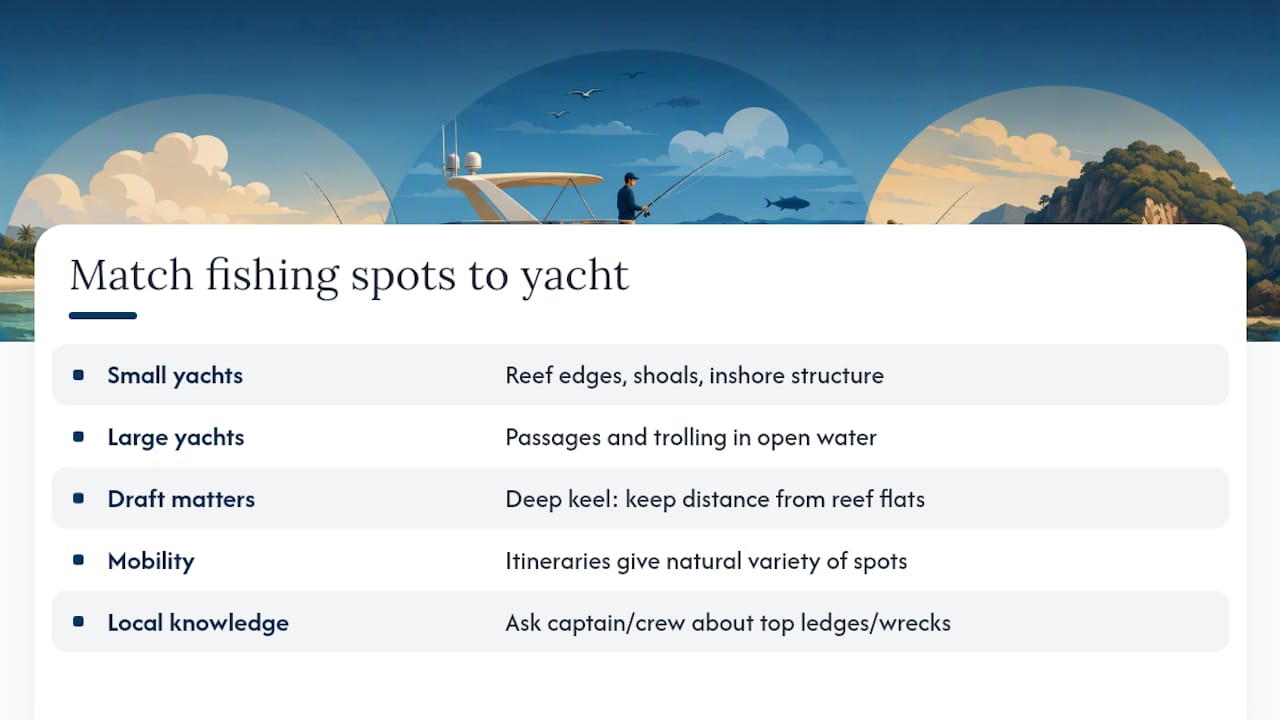
A 40-foot sailing yacht and an 80-foot motor yacht don't fish the same water, and matching your approach to the vessel you're on avoids a lot of wasted effort. Smaller, shallower-draft yachts can tuck close to reef edges, shoals, and inshore structure that a larger vessel simply can't approach safely, which opens up bottom fishing and light jigging over ground a bigger boat would need a dinghy to reach.
Larger motor yachts and catamarans, with more range and speed, are better suited to working passages between anchorages, trolling open water where pelagics feed along current lines rather than hugging structure. Draft matters just as much as length. A deep-keeled sailing yacht needs to anchor a respectful distance from shallow reef flats, while a catamaran's shallower draft allows anchoring closer to the kind of structure that holds snapper and grouper.
Mobility plays into this too. A yacht on a fixed itinerary with daily anchorage changes gets natural variety, since each new stop offers a different seabed, current, and species mix without any extra planning. A yacht anchored for several days in one spot benefits from fishing at different times of the tide cycle rather than the same spot repeatedly, since feeding activity around reef structure often shifts with tidal movement.
Ask the captain about local knowledge before assuming a spot is worth fishing. Crews who've worked a region for years often know which specific ledge or wreck outperforms open water by a wide margin, information no chart plotter shows.
Keeping Your Catch Fresh Until Dinner
Fresh fish degrades fast in tropical heat, and a yacht's limited refrigeration means storage discipline matters more than it would in a kitchen back home. Get the fish on ice within minutes of dispatching it, not after the rod is stowed and the deck is cleaned.
A few habits make the difference between a fish that tastes bright and one that tastes flat by dinner:
- Bleed the fish immediately after dispatch, since this single step affects flavor and shelf life more than almost anything else you'll do.
- Store fillets or whole fish directly on ice in a drained cooler, never in standing water, which softens flesh and speeds spoilage.
- Wrap fillets individually in plastic before icing them, which keeps meltwater off the flesh and prevents cross-contamination with other food in the same cooler.
- Cook or properly refrigerate the catch within hours if the boat's ice supply is limited, rather than assuming a cooler will hold overnight in warm climates.
If the plan is to serve the catch for that evening's dinner, coordinate with the crew early. Many charter crews build the day's fishing around the onboard meal plan, which means timing your fishing session a few hours before dinner service gives the galley the best possible fish to work with.
Fishing Responsibly Around Reefs and Open Water
Yacht fishing happens in some of the most fragile marine environments on the planet, and small habits onboard make a real difference to the health of that water. Never discard fish scraps, bait wrappers, or old line near reefs or anchorages, since discarded line in particular entangles marine life for years after it's tossed overboard.
Keep catch limits in mind even when no one's checking. Taking only what the group will actually eat that day, rather than filling a cooler out of momentum, keeps casual fishing sustainable in places where reef fish populations recover slowly. Respect no-take zones absolutely, since marine parks exist specifically to protect breeding populations that support the fishing everyone enjoys outside their boundaries.
Biodegradable waste and fish scraps still need proper disposal well offshore rather than near anchorages or reef structure, where concentrated scraps can attract unwanted predators close to swimmers or disrupt the local food chain. A hose-down of the deck after cleaning fish should happen with reef-safe soap if any is used at all, since ordinary detergents carry chemicals that harm coral and reef fish in shallow anchorages.
How Charter Crews Handle Guest Fishing
Charter crews handle the parts guests rarely think about: checking local permits, provisioning tackle, and confirming which zones are open before anyone asks to fish. Most crews offer to rig lines, manage storage, and clean the catch, turning a casual request into a smooth part of the day. Charter companies often work with captains and water sports professionals who bring practiced hands to fishing requests on remote itineraries.
— Mo
Ready to Fish on Your Next Charter?
Experienced captains and crew who know the local waters, the seasonal fish runs, and which anchorages produce a good bottom-fishing session versus which ones are strictly no-take provide advantages over rental boats or bareboat charters. That local knowledge is the real advantage over figuring it out yourself from a chart plotter and a guidebook.

Crews often provision gear, handle rigging, and manage the cleaning so the day focuses on the catch, not the logistics. Browse luxury yachts built for water-based itineraries, or look at charter yachts with scuba diving onboard if your trip blends fishing with time underwater. When booking, ask your specialist to confirm the onboard tackle list and local fishing conditions with the crew ahead of departure.
Sources
- Rod, Reel and Rum: The Pillars of Fishing Underway — Cruising World
- Fishing from a yacht (or mobo) — Boat-Angling
- CDC — Fish poisoning: ciguatera, scombroid