
The MYBA Charter Agreement is the industry-standard contract that governs how a luxury yacht charter is booked, provisioned, delivered, and legally resolved if something goes wrong. It protects both charterer and owner by standardizing the Advance Provisioning Allowance, the payment schedule, delivery and redelivery terms, and the governing law. Before you sign, you need to understand what each clause actually promises you.
TL;DR:
- Most disputes in MYBA charters stem from the reconciliation of the Advance Provisioning Allowance, delivery condition issues, and cancellation timing.
- The APA typically amounts to 25% to 35% of the charter fee, covering fuel, provisioning, dockage, and communication costs, with the remaining budget separate from the charter fee.
- Inspection of the yacht at delivery and redelivery is crucial, requiring documented condition checks and immediate broker intervention if the yacht is not ready or deviates from specifications.
- Cancellation tiers provide tiered refund percentages based on how close to departure the agreement is canceled, with most disputes arising from subjective judgment calls in these periods.
- Standard legal framework relies on English law, with arbitration in London, and owners are required to hold hull and liability insurance, but travelers should carry their own medical and travel coverage.
Table of Contents
- What Is MYBA, and How Does the MYBA Charter Contract Work?
- Reading the MYBA Contract Clause by Clause
- How the Advance Provisioning Allowance Actually Works
- Payment Terms, Security Deposit, and Gratuity Norms
- Delivery, Redelivery, and What to Do if the Yacht Isn't Ready
- Force Majeure, Breakdown, and Cancellation: Who Actually Bears the Risk
- Insurance, Liability Caps, and Where Disputes Get Resolved
- What You Can Negotiate Before Signing, and What Brokers Ask
- How Exotica Charters Verifies a MYBA Contract Before You Sign
- Why Most Charter Advice Misses What Actually Matters
- Sources
What Is MYBA, and How Does the MYBA Charter Contract Work?
MYBA stands for the Mediterranean Yacht Brokers Association, though the group now operates globally as the World Wide Yachting Association. Founded in 1984, MYBA publishes the charter and sale templates that dominate the industry and owns YACHTFOLIO, a database brokers use to verify yacht specifications and ownership records before drafting a contract.
Membership carries real weight. MYBA requires members to hold professional indemnity insurance and follow a formal Code of Conduct, which is why brokers treat "this is a MYBA contract" as shorthand for a fair, tested framework rather than a document drafted from scratch by one side's lawyer.
Two practical tools matter here for anyone booking or listing a yacht.
- MYBA Charter Agreement: the paper (or digital) template itself, covering everything from deposit terms to arbitration.
- MYBA E-Contract: a serially numbered document issued through MYBA's secure portal, allowing brokers and charterers to verify a contract's authenticity before wiring a deposit.
- YACHTFOLIO: the association's record system for confirming a yacht's registered specifications and legitimate representation.
Roughly nine in ten Mediterranean charters run on this template, and it has become common well beyond that region, which is exactly why understanding it clause by clause matters more than skimming a summary.
Reading the MYBA Contract Clause by Clause
A MYBA agreement runs long, but most of the risk sits in ten or eleven clauses. Here is what each one actually does once you're aboard, not just on paper.
- Parties and vessel identification. Names the charterer, the owner (or owner's company), and the yacht by registered name, flag, and specifications pulled from YACHTFOLIO. Mismatched details here are an early red flag.
- Charter period and cruising area. Locks in exact dates, delivery and redelivery ports, and the permitted cruising zone. Straying outside the agreed area without amendment can void certain protections.
- Charter fee. The base price for the yacht and crew, separate from provisioning, fuel, and dockage, which live in the APA.
- Advance Provisioning Allowance (APA). Covers running costs during the trip and gets reconciled afterward. More detail below, because this is where most disputes start.
- Payment schedule. Governs deposit timing, balance due dates, and currency, typically structured as a split rather than one lump sum.
- Crew and captain's authority. Confirms the captain has final say on safety, weather routing, and itinerary changes, regardless of what the itinerary promised.
- Delivery and redelivery. Specifies the condition the yacht must be in at handover and return, plus the inspection process.
- Insurance. Requires the owner to carry hull, machinery, and protection and indemnity coverage; charterers are expected to carry their own travel and medical insurance separately.
- Loss, damage, and security deposit. Sets the caution money amount and the conditions under which it's withheld, partially or fully.
- Force majeure and breakdown. Addresses what happens when weather, mechanical failure, or events outside anyone's control disrupt the charter.
- Cancellation. Defines tiered refund percentages depending on how close to departure the cancellation happens, and by whom.
- Governing law and jurisdiction. Names the legal framework and dispute resolution venue, almost always English law with London arbitration.
Pro Tip: Ask your broker for the amendment log, if one exists. Owners occasionally attach addenda that soften liability caps or change cancellation tiers, and those changes rarely get highlighted unless you ask directly.
The clauses most likely to cause friction are APA reconciliation, delivery condition disputes, and cancellation timing, because all three involve subjective judgment calls made under time pressure at the start or end of a trip.
How the Advance Provisioning Allowance Actually Works
The APA typically runs 25% to 35% of the charter fee, though remote or long-range itineraries can sit at the higher end because fuel and provisioning logistics cost more.
That allowance covers:
- Fuel for the yacht and water toys
- Food and beverages, including crew meals
- Dockage, marina, and port fees
- Communications and connectivity charges
- Miscellaneous provisioning requested before or during the trip
It does not cover the charter fee itself, gratuity, or major discretionary purchases like private shore excursions unless specified.
The reconciliation math is the part most first-time charterers underestimate. At the end of the trip, the captain provides an itemized breakdown. Unused funds get refunded, and any overage gets billed, sometimes before you disembark. Ask for a mid-charter APA update, not just a final tally. A captain who can show you spending pace on day four gives you room to adjust before day eight brings an unpleasant surprise.
Payment Terms, Security Deposit, and Gratuity Norms
Most MYBA charters split payment between a deposit due at signing and the balance due weeks before departure. Last-minute bookings inside that window often require the full amount upfront. Currency is usually specified in euros or US dollars, and for charters above roughly $500,000, legal review of the payment terms before signing is a reasonable precaution rather than an overreaction.
- Deposit: 50% at contract signing, non-refundable outside cancellation tier protections.
- Balance: due before delivery, timing varies by broker and owner.
- Security deposit (caution money): commonly ranges from roughly €5,000 to €20,000, held against damage and returned after a clean redelivery inspection.
- Gratuity: a customary recommendation of 10% to 18% of the charter fee, handled separately from the APA and typically given directly to the crew.
Delivery, Redelivery, and What to Do if the Yacht Isn't Ready
Delivery inspections should happen with both the charterer (or a representative) and the captain present, walking every cabin, checking equipment lists against what was promised, and photographing anything questionable before the charter clock starts.
- Confirm the yacht matches its YACHTFOLIO specifications on arrival.
- Photograph existing wear or damage before boarding gear or luggage.
- Get the captain's sign-off on the delivery checklist in writing.
- If the yacht isn't ready or doesn't match the contract, ask your broker to invoke delay or substitution remedies immediately, not after the trip starts.
Redelivery follows the same logic in reverse. Refunds or fee adjustments for a late or non-conforming delivery are typically pro-rated against the days lost, which is why documenting condition at both ends protects you either way.
Force Majeure, Breakdown, and Cancellation: Who Actually Bears the Risk
Force majeure clauses cover events genuinely outside anyone's control, weather systems, port closures, government restrictions, and generally lead to postponement or a partial refund rather than a full one. The 2022 MYBA edition, still the common baseline going into 2026, updated this language specifically after the pandemic exposed gaps in older templates.
Breakdown clauses are different: if a mechanical failure keeps the yacht from operating for a defined threshold of hours or days, charterers are usually entitled to a pro-rata refund for the time lost, not just a gesture of goodwill.
- Force majeure: postponement or partial refund; owner isn't penalized for external events.
- Mechanical breakdown: pro-rata refund tied to downtime hours.
- Owner cancellation: charterer typically gets a full refund plus, depending on timing, compensation or a replacement yacht offer.
Insurance, Liability Caps, and Where Disputes Get Resolved
Owners are contractually required to carry hull and machinery coverage plus protection and indemnity insurance covering the vessel and crew. That protects the boat, not you personally, which is why carrying your own travel and medical insurance matters regardless of how comprehensive the owner's policy looks on paper.
- Liability caps in the contract limit the owner's financial exposure for specific incidents, separate from the security deposit held against charterer-caused damage.
- Caution money functions as the practical first line of recovery for minor damage disputes, avoiding the need for formal claims.
- Governing law is almost always English law with arbitration seated in London, regardless of where the yacht sails or where either party resides, which matters if a dispute ever escalates beyond the broker's mediation.
What You Can Negotiate Before Signing, and What Brokers Ask
The core liability framework, insurance requirements, and governing law clause are essentially fixed. What's genuinely negotiable is narrower but still worth pushing on.
- APA percentage, particularly for longer or repeat charters
- Cruising area boundaries and specific delivery or redelivery ports
- Gratuity guidance language, if you'd rather it stay silent than prescriptive
- Timing of the balance payment relative to departure
Pro Tip: Ask your broker directly, "Is this the standard MYBA template, or does it carry owner addenda?" A yes to addenda isn't disqualifying, but it means you read those pages twice. Heavily modified clauses, unusual liability language, or a missing E-Contract serial number are all worth raising before funds move. For more on structuring these conversations, a negotiation walkthrough can help you frame questions before your broker call.
How Exotica Charters Verifies a MYBA Contract Before You Sign
Every charter arranged is checked against the yacht's YACHTFOLIO record and confirmed as a genuine MYBA template, addenda included, before it reaches a client's inbox. The team reads delivery and APA clauses carefully, focusing on practical implications rather than just the written words.
On remote itineraries, where provisioning costs can be higher and delivery ports difficult to inspect in person, interim APA reporting and detailed delivery checklists are strongly recommended as good practice. If you're weighing a luxury yacht charter built around diving or wildlife exploration, that same scrutiny applies whether the yacht is a 46-foot sport fisher or a full-crew superyacht.
Why Most Charter Advice Misses What Actually Matters
Most guides to the MYBA contract treat every clause as equally important, walking through the whole document like a legal syllabus. That's backwards. Three clauses, APA, delivery condition, and cancellation tier, generate nearly every real-world dispute I've seen discussed by brokers, and the rest of the document exists to protect you in situations that rarely occur.
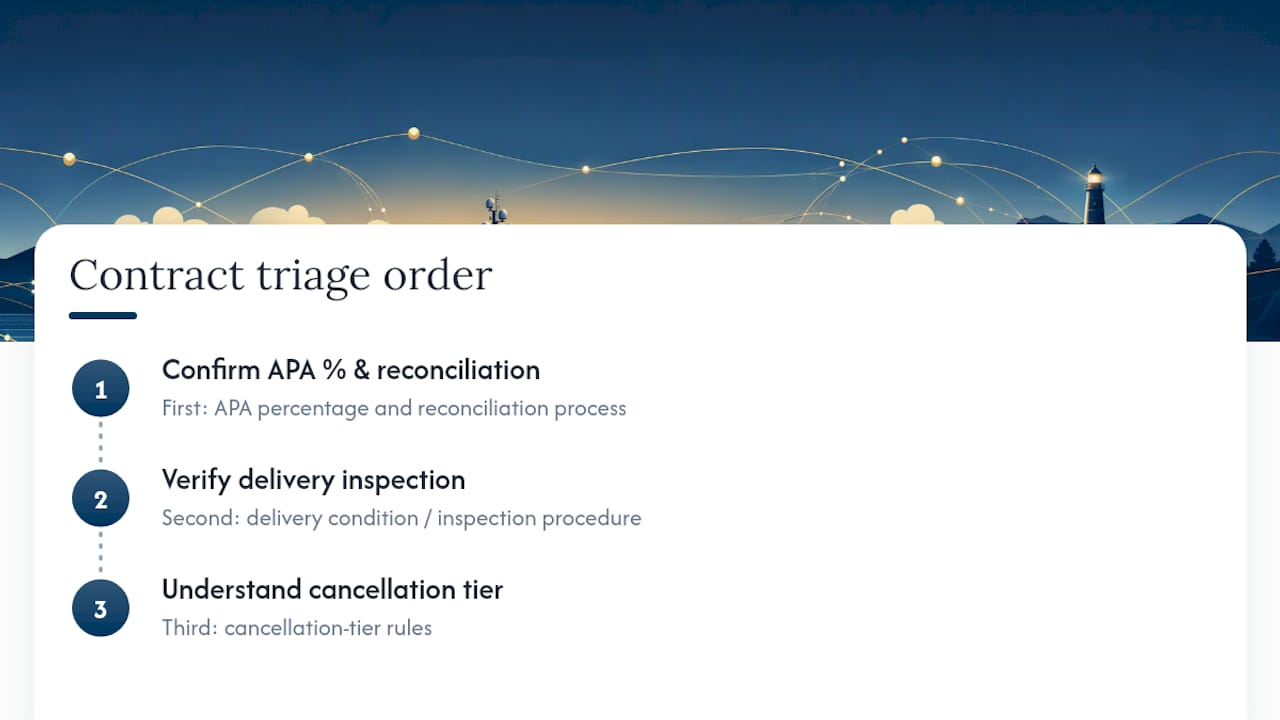
The conventional advice to "read the whole contract carefully" is true but useless on its own. What you should actually do is triage: confirm the APA percentage and reconciliation process first, verify the delivery inspection procedure second, and understand your cancellation tier third. Everything else, governing law, insurance structure, force majeure scope, is standardized enough across MYBA contracts that variation is rare and usually not worth fighting over.
Where I'd push back hardest on common practice: too many charterers treat the security deposit and APA as the same pool of money. They aren't, and confusing them is how people end up arguing with a captain on the last night of a trip that should have ended peacefully.
— Mo
Sources
- MYBA - The worldwide yachting association - Yachts and Brokers HOMEPAGE
- How to Read a MYBA Charter Agreement: Clause-by-Clause Guide