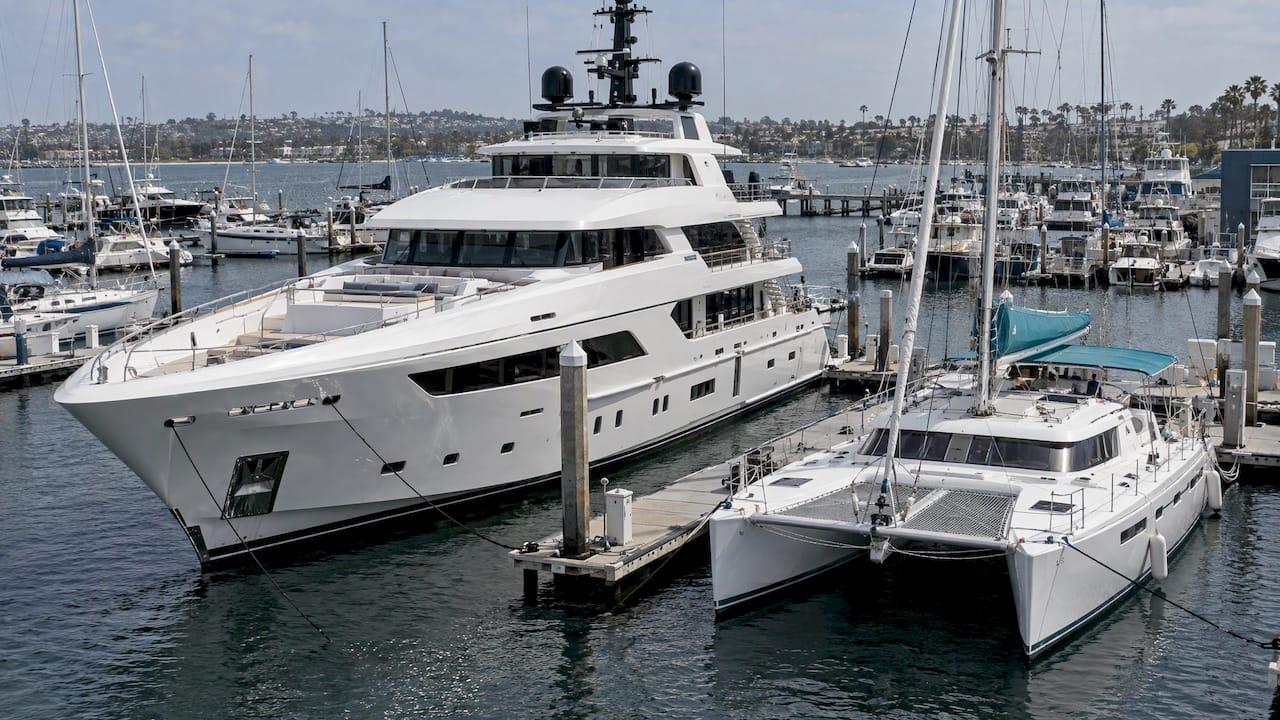
The question is a little like asking whether a house beats a beach villa, because the two categories overlap. A superyacht is defined by size, generally a pleasure vessel over 24 metres (80 feet). A catamaran is defined by shape: two parallel hulls joined by a deck. A catamaran can be a superyacht, and most of the time the real choice is between a large, deep-hulled motor or sailing superyacht and a twin-hulled catamaran, whatever its length. Choose the catamaran for stability at anchor, living space and shallow anchorages. Choose the monohull superyacht for long open-water passages, a deeper bank of amenities and the full-service scale that only a big vessel offers. Our team of former captains and water sports professionals plans both, and Exotica Charters can match the vessel to the trip you actually want.
TL;DR
- A catamaran has two hulls; a superyacht is any large yacht over roughly 24 metres (80 feet). The two overlap, since catamarans are built at superyacht length too.
- Catamarans gain stability from their wide beam, usually draw less water and heel far less, which suits families, first-time charterers and shallow, remote anchorages.
- Motor superyachts generally offer more interior space and amenities for long-distance cruising because they do not depend on wind.
- Match the vessel to the itinerary: reefs and lagoons favor a catamaran; long ocean legs and maximum service favor a larger monohull.
- Before you sign, get the costs in writing and confirm the vessel's inspection status and the captain's credentials.
Table of Contents
- What actually separates a superyacht from a catamaran
- Space and layout: where a catamaran surprises people
- Stability and comfort at sea
- Speed, handling and getting to shallow places
- Privacy, service and scale
- Which one suits your trip?
- What to check before you sign
- Plan your charter with Exotica Charters
- FAQ
- Sources
What actually separates a superyacht from a catamaran
The words describe different things, which is why search results for this question tend to talk past each other.
Superyacht is a size category. The usual threshold is 24 metres (80 feet) for a sailing or motor pleasure craft, and the category runs up through the 100-foot, 150-foot and 200-foot classes. A superyacht may be a motor yacht, a sailing yacht, an expedition vessel or a multihull.
Catamaran is a hull form. As Boat International's guide to yacht types puts it, a catamaran is a multihull with two parallel hulls connected by a central platform or deck. Catamarans come as sailing cats and as power cats, and they are built from compact charter sizes to well beyond 80 feet.
So the practical comparison is between two design philosophies:
- The traditional monohull superyacht, one deep hull, ballast or a deep keel on sailing yachts, a displacement or semi-displacement hull on motor yachts.
- The catamaran, two slender hulls, a wide beam, a shallow draft and a broad open deck.
If you are browsing our fleet, you will see the split in our categories: luxury yachts, motor yachts, sailboats, catamarans and power catamarans, alongside expedition vessels for the most remote water.
Space and layout: where a catamaran surprises people
A catamaran spreads its volume across the beam instead of down into the hull. The result is a different kind of space. A YachtWorld comparison notes that the extra deck, cockpit and cabin volume can make a 40-foot catamaran roughly comparable in usable space to a 50-foot monohull.
In practice that means:
- Social space. A large saloon opening onto an aft cockpit, often with a flybridge above, lets a family or a group of friends share one connected living area.
- Cabin separation. Cabins sit in separate hulls, which gives couples and families a quiet retreat from the main saloon.
- Deck room. Wide foredecks and trampolines suit sunbathing, snorkel staging and children who need room to move.
A monohull superyacht answers with scale and depth. Boat International's guide notes that motor yachts generally offer more interior space and amenities for long-distance cruising because they do not depend on wind. In the largest sizes you move into a different world: multiple decks, a dedicated crew wing, a tender garage, spa and gym areas, and a long list of guest cabins. Where a catamaran feels open and airy, a motor superyacht feels like a floating hotel.
Stability and comfort at sea
This is the question readers raise most: does a catamaran ride better?
The physics explain the answer. A monohull gets its righting force from ballast and a deep keel, so it heels under sail. A catamaran gets its stability from the separation between its two hulls, so it stays essentially flat. That is why guests on a cat tend to find life aboard more like living in a house: glasses stay on the table and dinner is served without tilting.
There is a trade-off worth understanding so you can pick the right setting for the right boat. YachtWorld's comparison says cats are usually more comfortable for families and for guests prone to seasickness because they heel less and roll less at anchor. The same comparison adds that a cat can pound upwind in big seas, and its motion is not universally preferred. A well-designed monohull, especially a large one, can feel smoother in long-period ocean swell, where its weight and deep hull work in its favor.
A simple way to think about it:
| Condition | Catamaran | Large monohull superyacht |
|---|---|---|
| At anchor in a calm bay | Very steady, little roll | Steady, may roll in swell |
| Under sail | Flat, little heel | Heels, sails closer to the wind |
| Steep, short coastal seas | Can pound on the bridge deck | Generally more forgiving |
| Long ocean swell | Livelier | Often smoother |
| Seasickness-prone guests | Often the easier option at anchor | Depends on route and weather |
On a charter, most of your time is spent at anchor, in a harbor or on short hops between islands. That is where the catamaran's advantage is most obvious. If your itinerary includes a multi-day open-water crossing, talk to your charter specialist about weather windows and vessel choice before you commit.
Speed, handling and getting to shallow places
Catamarans have less drag and lighter construction, and Boat International notes that this can increase speed. A Boat Gold Coast comparison suggests multihulls may be around 25 percent faster than equal-length monohulls in general conditions, while monohulls usually point higher into the wind. If you are sailing a tight upwind course, a monohull is the more efficient tool. For reaching along a coast with a following breeze, a cat tends to shine.

Handling differs too. YachtWorld's comparison says cats generally have better control at low speed because their twin engines sit far apart, which helps in tight anchorages and marina approaches.
Shallow draft opens up the map
The other big difference is draft. Most multihulls sit shallow, and that matters more than any specification you will read on a brochure. A shallow-draft vessel can slip into lagoons, tuck close to a reef edge or anchor near a beach where a deeper hull has to stay offshore. For divers, it means shorter tender runs and calmer water around the dive site. For families, it means swimming directly off the stern in clear, protected water.

Southern California shows how much coastal geography shapes a day on the water; these Catalina Island day trip itineraries are a good picture of the kind of island hopping that suits shallow, easy anchorages. For a deeper look at the subject, our own guide to shallow draft versus deep draft explains how draft changes what a charter can reach.
Bigger monohull superyachts have the opposite strength. Their deeper hulls and greater displacement give them range, sea-keeping and the capacity to carry equipment such as dive compressors, a large toy garage and extra fuel for remote expeditions.
Privacy, service and scale
Privacy is where a superyacht often wins. A larger vessel carries a larger crew, so the ratio of service to guests can be very high, and guest and crew areas are cleanly separated. You can have a quiet deck to yourself even with a full group aboard.
Crewed catamarans deliver intimacy in a different way. A smaller crew, often a captain, a chef and a deckhand or two, tends to create a closer, more personal rhythm. Many couples prefer exactly that: a handful of people who know your name by the second morning.
Before you decide on scale, ask what you want from the crew:
- A dedicated dive instructor or water sports team is easier to accommodate on a larger vessel.
- A close, personal atmosphere often suits a catamaran.
- Several cabins with equal-sized suites suit groups of couples, and many catamarans are laid out this way.
- A master suite with significant separation and a larger staff suits a superyacht.
Our guide to what a superyacht charter involves goes through service levels in more detail, and our overview of yacht charter types helps you see where each style fits.
Which one suits your trip?
Family vacation
A catamaran is usually the first suggestion. YachtWorld says a cat may suit a big crew with newcomers for its room and family-friendly motion. Flat decks, shaded cockpits and easy water access are good with children, and sleeping in separate hulls means early risers do not wake the whole boat. For a very large family or multi-generational group, a larger motor yacht or a superyacht-size catamaran can also work.
Diving
Both work, but for different styles. A catamaran gets you close to shallow reefs and sheltered sites and offers a large rear platform for kitting up. A larger motor yacht or expedition vessel suits remote liveaboard-style itineraries, where range, onboard compressors, a full tender and a dedicated team are the priority. Because our team includes water sports professionals, diving is a natural starting point when we plan an itinerary.
Wildlife and expedition travel
Remote destinations such as the Galápagos, French Polynesia and Alaska reward a vessel built for the water. Cats can reach quiet bays and shallow coves; expedition-capable motor yachts handle long legs and cold, exposed water. Our guides on what makes a yacht suitable for polar or expedition waters and what activities an expedition charter includes explain how that choice works in practice.
Romantic getaways
Couples often pick a crewed catamaran for the quiet, the space and the steady motion at anchor. If you want a more formal, hotel-like experience, with a large master suite and a bigger crew, a luxury motor yacht is the natural fit. For a close comparison in one destination, read crewed catamaran versus motor yacht in the Maldives.
A quick decision guide
| If you want... | Lean toward |
|---|---|
| Steady motion at anchor and room to spread out | Catamaran |
| Shallow lagoons, reefs and quiet coves | Catamaran |
| Long ocean passages and maximum range | Monohull motor yacht or expedition vessel |
| A large crew and spa-level amenities | Motor superyacht |
| Sailing closer to the wind | Monohull sailing yacht |
| Superyacht scale and a multihull's space | Catamaran superyacht |
What to check before you sign
Whatever the hull shape, a charter is a large commitment, and a few checks protect you.
- Inspection status. The U.S. Coast Guard says passengers on charter boats carrying more than six passengers should ask to see a Certificate of Inspection. It also says mariners operating a vessel for hire are required to hold a Merchant Mariner Credential.
- Safety and legality. The same Coast Guard release warns that illegal charter operations often lack the necessary safety equipment and may not meet the same standards as legal charters, so verify the captain's credentials and safety plan before boarding.
- Passenger limit and layout. Confirm the certified passenger limit, the number of berths and the cabin layout, so that the boat sleeps your group the way you expect.
- Crew and itinerary. Ask how long the crew has been aboard, whether the captain has run your itinerary before, and who decides on itinerary changes.
- Costs in writing. Ask for a written breakdown listing the charter fee, applicable tax, advance provisioning allowance and planned gratuity as separate lines, plus a list of what is excluded, such as fuel, dockage, food and drink, transfers and park fees.
No two quotes are alike, so compare them line by line on a like-for-like basis. Pricing varies widely with vessel size, season, destination and crew, and a superyacht in a major U.S. port is priced very differently from a crewed catamaran in a remote anchorage. Our own overview of how expedition charters are priced shows what goes into a figure.
Our view: pick the water first, then the hull
We start every conversation with the destination and the kind of day you want, never with a boat. A reef-fringed lagoon, a glacier-fed fjord and an open ocean passage ask different things of a vessel, and a former captain reads those differences quickly.
Our rule of thumb is simple. If your time is mostly spent at anchor, swimming, diving and exploring close to shore, we would suggest a catamaran: the steadiness, the space and the shallow draft make every day easier. If your route includes long passages, cold or exposed water, or you want the full scale of a large crew, we would suggest a motor yacht or an expedition vessel. And when you want both, a catamaran of superyacht size brings the two together.
We built our team from former captains and water sports professionals because the right answer depends on experience of the water, and we plan each itinerary around that.
Mo
Plan your charter with Exotica Charters
We plan fully crewed charters on sailing yachts, motor yachts, catamarans and superyachts, and we shape each itinerary around diving, wildlife and adventure in remote destinations. If you are weighing a catamaran against a larger yacht, tell us your group, your dates and the water you want to reach, and we will build the options around you. You can browse catamarans in selected locations or luxury yachts in selected locations, or start from our main charter page.
Our clients rate us highly on Trustpilot, and we would be glad to speak with you about your trip.
FAQ
Can a catamaran be a superyacht?
Yes. Superyacht describes size, generally over 24 metres (80 feet), not hull shape. Catamarans are built at those lengths, so a large catamaran can be both. Many guests choose them for the combination of space and a steady ride.
Does a catamaran ride better than a monohull?
At anchor and in calm to moderate coastal water, usually yes, because a catamaran stays essentially flat instead of heeling. YachtWorld's comparison says cats heel and roll less, which helps guests prone to seasickness. In steep, short seas or long ocean swell, a larger monohull can feel smoother.
Is a catamaran or a superyacht better for a family?
For most families a catamaran is the natural starting point, with its wide decks, separate hulls and easy swimming access. A larger motor yacht suits big groups wanting more crew and amenities. Tell us your group size and ages, and we will suggest the right fit.
Which is better for diving and wildlife trips?
It depends on the route. A catamaran's shallow draft gets you close to reefs and quiet coves. A larger motor yacht or expedition vessel suits remote itineraries with long legs and a full team. Our team's water sports background shapes how we plan either one.
What should I ask before booking a charter?
Ask for a written cost breakdown with exclusions, the certified passenger limit and the captain's credentials. For charters with more than six passengers, ask to see the Coast Guard Certificate of Inspection. Confirm who decides itinerary changes and what the crew's experience is on your route.
Sources
- Types of yachts: motor yachts, sailing yachts, catamarans and more (Boat International)
- Catamarans Vs. Monohulls: Choosing The Right Boat (YachtWorld)
- Mono or Multi: Which Hull is Better? (Boat Gold Coast)
- Coast Guard warns public of risks associated with illegal charter (U.S. Coast Guard)