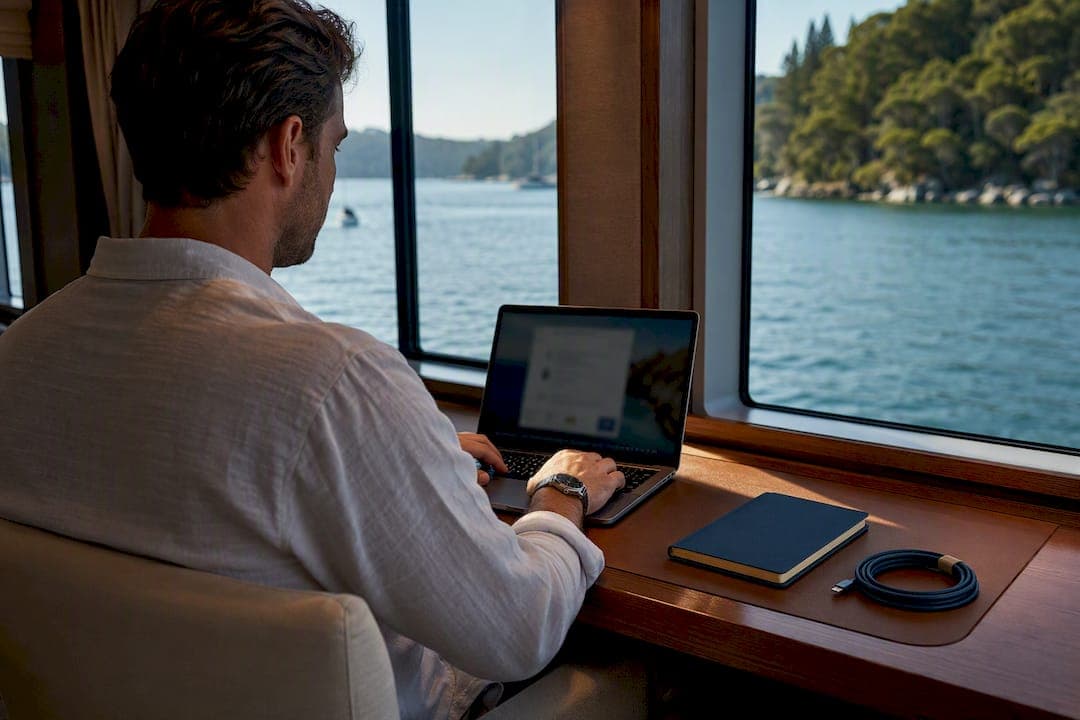
Yes, you can run real work from a fully crewed luxury yacht, provided the vessel meets three conditions: redundant high-speed connectivity, a quiet dedicated workspace, and a crew experienced with working charters. Miss any one of these, and your "floating office" becomes an expensive place to miss deadlines. Get all three right, and a working charter often outperforms your actual office. A team staffed by former captains and water sports professionals builds itineraries around exactly these requirements.
TL;DR:
- Reliable connectivity requires dual systems like Starlink and VSAT, with tested speeds in the cruising area and real-world validation before critical meetings.
- A dedicated private workspace with soundproofing, ample outlets, adjustable lighting, and ergonomic seating is essential for productive work onboard.
- Crew with prior experience supporting working charters can significantly improve your schedule, especially if they can test AV setup and prepare meeting spaces in advance.
- For long crossings, plan work around anchor days to minimize motion disturbances and ensure access to power backup solutions for uninterrupted device use.
- Understanding the vessel layout, itinerary, and weather conditions ahead of time helps optimize your work schedule and avoid disruptions during transit or rough seas.
Table of Contents
- What Does It Take to Work From a Yacht Successfully?
- How to Choose the Right Yacht and Itinerary for Your Schedule
- Coordinating With Crew When Your Trip Is Meeting-Heavy
- Setting Up Secure, Reliable Networks Onboard
- Building a Daily Schedule That Actually Works
- Power Supply and Backup Options for Continuous Work
- Emergency Protocols and Contingency Plans During Work Hours
- Legal and Regulatory Considerations for Remote Work Onboard Yachts
- Weather, Sea State, and Their Real Effect on Your Workday
- Lessons From Captains Who Run Working Charters
- Let Exotica Charters Build Your Work-Ready Itinerary
- Sources
What Does It Take to Work From a Yacht Successfully?
Before you book anything, ask the right questions. A broker who cannot answer these in detail is not the right broker for a working charter.
Start with connectivity, because it determines everything else. Ask whether the yacht runs maritime Starlink, and whether it is a single dish or a dual-dish setup for redundancy. Dual systems, or Starlink paired with a VSAT fallback, are what separate an occasional dropped call from a reliable connection your business can depend on. Low-Earth-orbit satellite systems have made stable video conferencing at sea genuinely common, and the strongest working charters now treat that redundancy as standard, not an upgrade. Near coastlines, bonded cellular data adds a third layer. Request the vessel's recorded real-world speeds in your specific cruising area, not a generic spec sheet.
Workspace matters just as much. Look for a private room with a door, or a convertible salon and sky lounge with real sound dampening, not just a nice view and a dining table. Confirm outlet count, seating that will not wreck your back after a four-hour call block, and lighting that will not blow out your video feed at sunset.
Crew experience closes the loop. Ask directly whether the crew has run working charters before, whether they will clear and prep a meeting space on request, and whether meal service can flex around your call schedule.
- Confirm dual connectivity (Starlink plus VSAT or bonded cellular) and ask for tested speeds in your cruising ground
- Request a private office or convertible quiet room, not just "good Wi-Fi in the salon"
- Ask for specific examples of prior working charters the crew has supported
Pro Tip: Ask your broker to have the captain test a live video call from the actual anchorage you plan to work from, not the marina, before you commit to dates.
How to Choose the Right Yacht and Itinerary for Your Schedule
Layout and route decisions should follow your calendar, not the other way around. If your days are packed with back-to-back video calls, a dedicated office with a closing door is worth prioritizing over square footage elsewhere. If your work is mostly async, email, and the occasional call, a convertible salon with good acoustics will usually do the job. Vessel motion and engine noise affect call quality more than most first-time charter clients expect. A yacht running generators at anchor for air conditioning can introduce a low hum that ruins a recording. Ask about anchor-power options before you fall in love with a layout.
Itinerary shapes your workday just as much as the boat does. Short-hop cruising grounds, the Caribbean, the Bahamas, the Ionian, let you move daily while staying close to reliable coverage and predictable schedules. Longer ocean passages are a different animal: connectivity can dip mid-crossing, and itinerary planning should start with your meeting calendar, not the map.
- Short hops suit daily calls and predictable connectivity; long passages suit blocked-off deep work with planned downtime
- Match your cruising region to your core office hours, or shift your schedule deliberately rather than by accident
- Ask the broker to propose crossing and anchor windows that protect your meeting blocks specifically
Time zones deserve a direct conversation with your broker before routes get finalized, not an afterthought once you are already aboard.
Coordinating With Crew When Your Trip Is Meeting-Heavy
A working charter runs smoothly when the crew knows your schedule before you step aboard, not after your first missed call. Brief the captain and chief steward early.
- Share your meeting calendar in advance and flag which calls are high-stakes versus routine
- Request quiet windows around critical calls, including reduced engine and generator noise
- Ask for an AV check of your meeting space the morning of any important presentation
Meeting etiquette on a yacht is slightly different from a home office. Mute discipline matters more when tender engines or crew activity are audible in the background. Choose a discreet backdrop for video calls, ideally something that doesn't broadcast exactly which yacht or region you're in, particularly for confidential business. If documents need signing during a shore excursion or tender run, plan that logistics gap ahead of time rather than scrambling dockside.
Reasonable crew requests include clearing a salon, providing refreshments timed around your call, and testing your connection beforehand. Anything beyond that, dedicated IT support or extra stewarding for a multi-day conference, should be arranged with the broker in advance.
Pro Tip: Tell the crew which calls are simply routine and which ones matter, so quiet-hour requests don't turn into constant interruptions of everyone's day.
Setting Up Secure, Reliable Networks Onboard
Marine internet is not your home network, and treating it that way is how sensitive business data gets exposed. Ask for a separate corporate Wi-Fi network apart from the guest network, along with enterprise-grade router or firewall management and genuinely strong passwords, not the boat's default credentials taped to a cabin wall. Network segmentation and VPN use are standard enterprise security practices that apply just as directly at sea as they do in a corporate office.
If your work involves confidential data, bring your own hardware VPN or a travel router rather than relying entirely on the yacht's setup. Test a full video call on the actual onboard network well before any meeting that genuinely matters, ideally the day before, not five minutes prior.
- Request separate guest and corporate networks with managed firewall settings
- Use a corporate VPN for anything sensitive, and bring backup hardware if your company requires it
- Test calls on the yacht's live network ahead of high-stakes meetings, not just at the dock
Even redundant systems can experience latency or brief drops in weather or remote anchorages. Build in a backup plan for anything mission-critical: a secondary call time, or a co-host onshore who can carry a meeting if your connection blips at the wrong moment.
Building a Daily Schedule That Actually Works
Two templates cover most working charter guests, and knowing which one fits you shapes everything from cabin choice to anchorage timing.
Template A, the distributed workday, suits people with frequent shorter calls throughout the day.
- Morning video calls from the office or convertible salon
- Mid-morning anchor move for a shore excursion or water activity
- Afternoon spent on lighter follow-up emails and messages
- Evening team sync before dinner
Template B, the deep-work day, suits people whose real output happens in long, uninterrupted blocks.
- Full morning blocked for focused work, engines off if possible
- One late-afternoon call, scheduled and confirmed the day before
- Remaining afternoon left open for diving, exploring, or simply resting
Either template depends on the same operational move: book anchorages in advance, request minimal engine time during your work blocks, and have the crew test your AV setup before, not during, your first call of the day.
Power Supply and Backup Options for Continuous Work
A dropped call is often not a connectivity failure. It is a power failure disguised as one. Yachts typically run on generator power, shore power at the dock, or battery banks at anchor, and each has implications for your workday. Generators cycling on and off introduce noise and occasional voltage fluctuation, which matters if you are running multiple monitors, a hardwired router, or recording equipment. Ask your broker whether the vessel has inverter systems that provide clean, consistent power during generator cycling, since this protects sensitive electronics from surges.
Battery capacity matters most at anchor, when the crew may reduce generator runtime overnight or during quiet hours. If your work requires charged devices and a live connection at 6 a.m. before the generator restarts, say so explicitly when planning your itinerary. Bring a portable battery pack or UPS unit for your laptop and router as a personal backup layer. It is inexpensive insurance against a mid-call blackout.
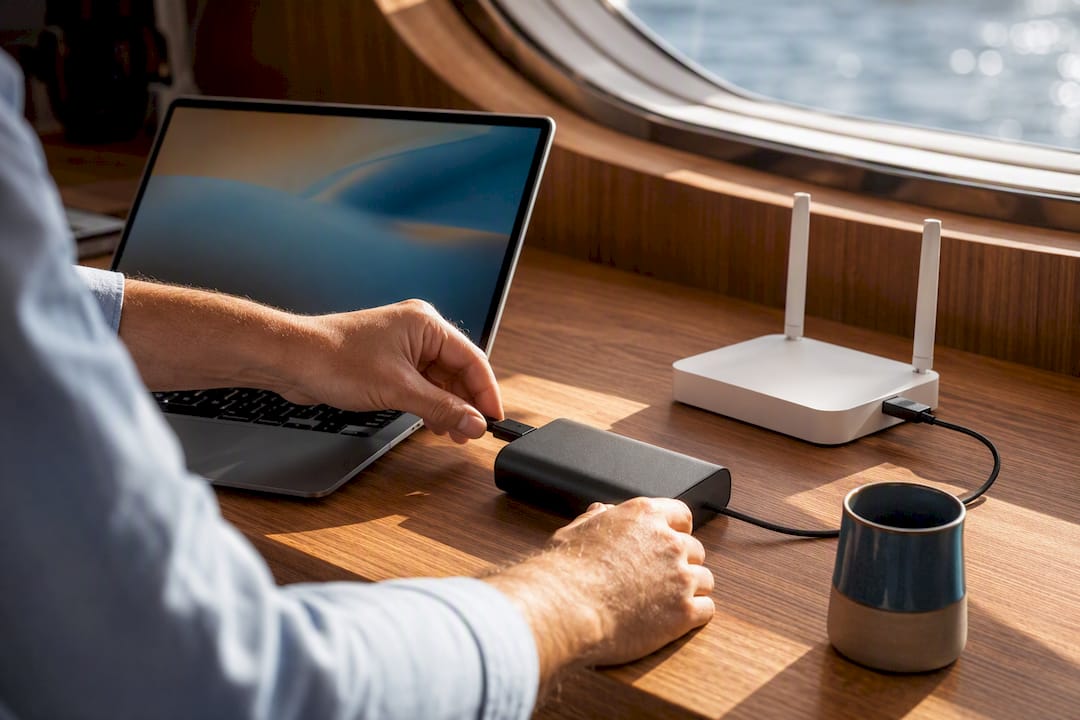
Confirm outlet placement in your intended workspace too. A beautifully designed cabin with one outlet behind a bed frame is not a workspace, it's a design problem you'll discover the hard way. Ask for a walk-through or photos of the specific desk or table you plan to use, including outlet count and placement, before you finalize your booking.
Emergency Protocols and Contingency Plans During Work Hours
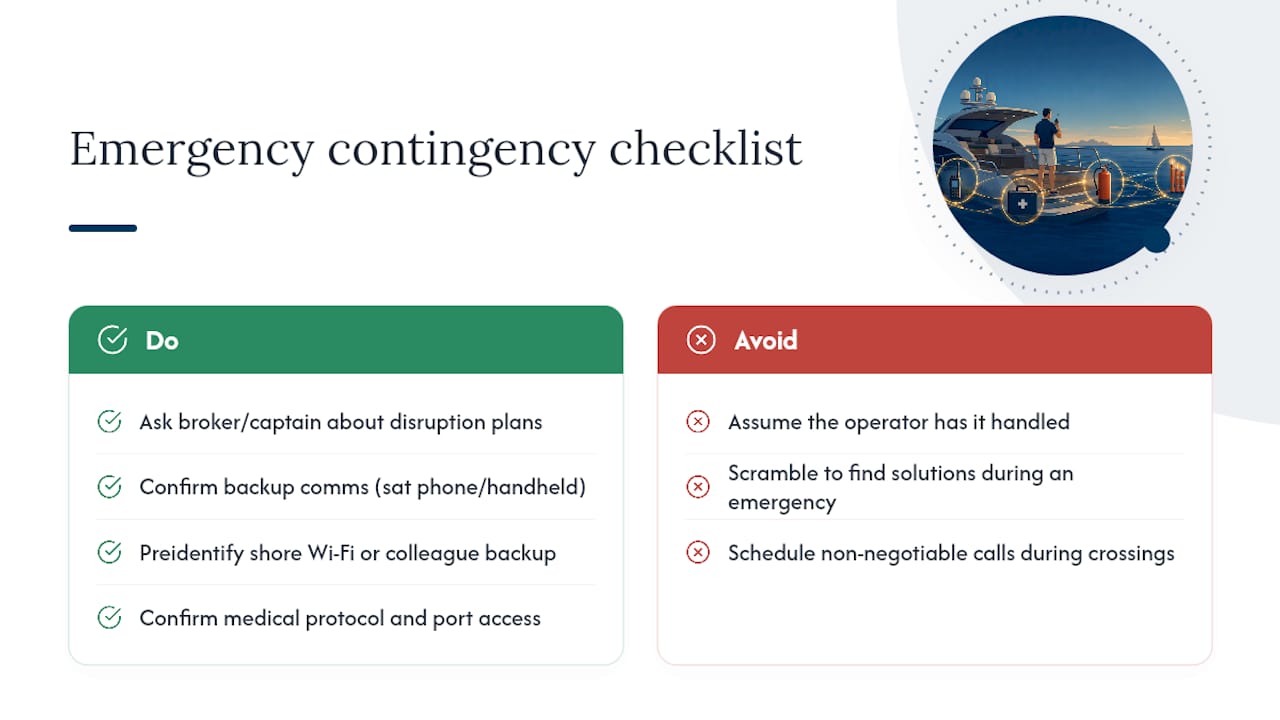
Weather, mechanical issues, and medical situations do not pause for your calendar, and a working charter needs a contingency plan that accounts for that reality. Ask your broker and captain upfront how the crew handles a schedule disruption, whether that's an unplanned anchorage change due to weather or a mechanical delay that shifts your entire day.
A reasonable contingency plan includes a backup communication method if satellite connectivity drops entirely, typically a satellite phone or handheld device the crew carries for exactly this scenario. If you have a meeting you genuinely cannot miss, identify a shore-based backup location, a marina with reliable Wi-Fi, or a colleague who can join in your place, before you need it rather than while scrambling for one.
Medical emergencies, though rare, deserve the same advance planning. Confirm the crew's protocol for reaching medical support in your cruising region, and understand how quickly the yacht can reach a port with facilities if needed. This is standard practice for any reputable operator, but it is worth confirming directly rather than assuming.
Build slack into your own schedule too. If a client call is truly non-negotiable, avoid booking it during a planned crossing or a day with forecasted rough seas. A little scheduling caution prevents a lot of stress.
Legal and Regulatory Considerations for Remote Work Onboard Yachts
Working while chartering as a guest is different, legally, from being employed as crew, and that distinction matters. As a charter guest doing your own remote work, you are not subject to maritime labor regulations that govern paid crew members; you are simply a traveler who happens to be working from a boat.
That said, a few practical considerations remain worth a conversation with your employer or accountant before departure. If your work involves regulated data (legal, medical, financial), confirm your company's remote work policy covers international waters and multiple jurisdictions, since a charter itinerary may cross several countries' waters in a single week. Tax residency rules vary by country and by how many days you spend where, so extended working charters that stretch across borders are worth a quick check with your own tax advisor rather than an assumption.
Business communications and data handling should also meet whatever compliance standards your industry already requires, whether that's client confidentiality rules or industry-specific data protection standards. None of this changes because you're on a yacht instead of in an office, but it's easy to overlook amid the excitement of planning a trip.
Weather, Sea State, and Their Real Effect on Your Workday
Sea conditions influence your productivity more directly than most first-time working charter guests expect. A calm anchorage in a protected bay delivers a stable video call and steady internet. A yacht underway in moderate swell delivers neither, and even minor motion can make screen work uncomfortable over long stretches.
Plan your highest-stakes calls and deepest-focus work for anchor days, not transit days. If your itinerary includes an open-water passage, treat that day as lower-productivity by design, catching up on email or handling asynchronous tasks rather than scheduling a client presentation. Rough weather can also affect satellite connectivity temporarily, since dish alignment and signal strength can be disrupted by significant vessel motion.
The upside works in your favor too. A well-planned itinerary front-loads calm-water days into your busiest work periods and saves rougher passages for days you've already planned as lighter. This is exactly the kind of routing decision an experienced captain makes automatically, once they know your schedule matters as much as the destination.
Lessons From Captains Who Run Working Charters
The pitfalls we see most often aren't dramatic. They're small oversights: a stateroom chosen for the view instead of the quiet, a call scheduled during a planned crossing, a power setup that wasn't stress-tested before day one. Experienced crews solve these with simple fixes, reserving a specific cabin for calls, running a test video conference the morning guests arrive, and scheduling engine-off windows around anything genuinely important.
What separates a smooth working charter from a frustrating one usually isn't the yacht. It's the planning that happens before anyone steps aboard. A captain who verifies connectivity in your actual cruising area, and a broker who builds the route around your calendar first, prevent nearly every problem this article covers.
— Mo
Let Exotica Charters Build Your Work-Ready Itinerary
Planning a working charter yourself means chasing down connectivity specs, workspace details, and crew experience across dozens of yacht listings, one email at a time. This verification work is done before you ever see an itinerary. It confirms dual-connectivity setups, private workspace layouts, and crew briefings tailored to your meeting schedule, so you're not gambling on whether the boat can actually handle your workday.
Some teams built from former captains and water sports professionals understand what a real working charter requires because they've run vessels, not just brokered them. That background, paired with customer reviews, shapes how some curate yacht recommendations. Browse our current luxury yacht options, explore a crewed yacht suited to executive travel, or look at how we frame expedition-style charter experiences that blend real work with genuine adventure. If your desk setup needs to double as a private office, the space-planning approach used by firms like One Day Doors & Closets offers useful ideas for creating a private zone without losing an open, relaxed feel onboard. Reach out to request a bespoke recommendation and a planning call, and we'll match a yacht and itinerary to your actual calendar, not a generic charter week.
Sources
For more on the connectivity trends and onboard design shaping working charters, see South Magazine's reporting on Starlink and the charter calendar and Business Traveller's feature on superyachts as remote offices. Explore Exotica Charters directly for current yacht options.
- Work From the Water: How Starlink Rewrote the Yacht Charter Calendar | South Magazine