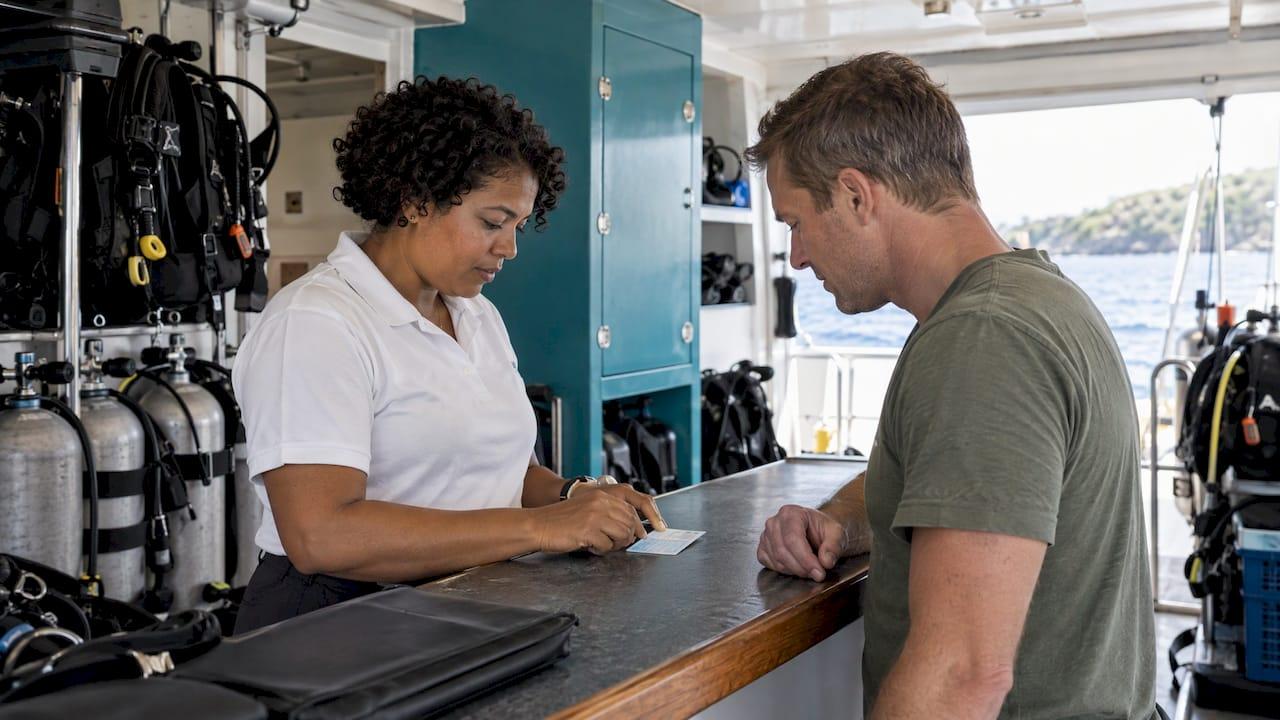
Most dive charters ask for an Open Water certification at minimum, and many ask for Advanced Open Water, Nitrox, a set number of logged dives or recent diving. The exact bar is set by each operator and by the dive site, not by one universal rule. A shallow reef day and a drift dive in current can have very different entry requirements, and on a remote yacht charter we plan the diving to match the least experienced diver in your party.
Below, we walk through the certification levels, the experience operators look for, the paperwork to carry, and how to confirm everything before you pay a deposit.
TL;DR
- Open Water Diver is the usual minimum for guided charter dives; Advanced Open Water is often asked for deeper, current-swept or wreck sites.
- Some charters add Nitrox, a minimum number of logged dives (25 is a common figure) or a recent dive within the past year.
- Not certified? A Discover Scuba experience is a supervised introduction, not a certification, and it opens only the most basic dives.
- Carry your certification card (and a photo of it), your logbook, and a completed medical questionnaire if any answer is "yes."
- Ask the operator or your charter specialist in writing which level each planned site needs, before you book.
Table of Contents
- Do you need to be certified to join a dive charter?
- Which certification level do charters ask for?
- How many logged dives and how recent?
- Age, swimming ability and medical fitness
- How to confirm requirements for your charter
- Day boats versus private crewed charters
- Our perspective
- Plan your dive charter with us
- General expectations before any guided ocean dive
- FAQ
- Sources
Do you need to be certified to join a dive charter?
For most charters, yes. A certification card shows you have been trained to plan a dive, manage your air, control buoyancy and handle problems underwater. Boat crews rely on that card because they cannot teach fundamentals while managing a vessel, a surface watch and a group of divers.
There is one common exception. A Discover Scuba experience is not a certification course and takes place under direct professional supervision; the Fort Lauderdale program can include an ocean dive on a shallow reef. It is a taste of diving, so expect a one-to-one or small-group format, a limited depth and a dedicated instructor, not a place in a regular charter group.
If someone in your party is not certified, there are three sensible paths:
- They snorkel while certified guests dive, which works well on most remote itineraries.
- They try a supervised introductory dive where an instructor is available.
- They complete the pool and classroom portions of an Open Water course at home and finish the open-water dives on the trip, if the operator offers it.
Our page on scuba diving on an expedition charter explains how this is usually arranged on a yacht.
Which certification level do charters ask for?
The level matters because it is tied to depth and conditions. Open Water divers are typically limited to 18 meters (60 feet), while Advanced Open Water raises the recommended maximum to 30 meters (100 feet). Many popular reefs, walls and wrecks sit below 18 meters, so operators often set Advanced as the entry point for them.
| Level | What it typically allows | When a charter asks for it |
|---|---|---|
| Discover Scuba (not a certification) | Supervised, shallow dives with an instructor | Shallow reef introductions, never regular groups |
| Open Water Diver | Dives to about 18 m / 60 ft with a buddy | Gentle reefs, calm sites, resort-style charters |
| Advanced Open Water | Dives to about 30 m / 100 ft, plus deep and navigation skills | Walls, wrecks, currents, deeper sites |
| Nitrox (enriched air) | Longer no-decompression times on suitable dives | Operators that fill Nitrox or run multi-dive days |
| Rescue Diver and above | Self-reliance and incident management | Rarely a requirement for guests; common for professional training |
Certifications from the major training agencies, such as PADI, SSI and NAUI, are generally recognized as equivalent at Open Water and Advanced levels, though a given operator may prefer to verify the card itself.
Specialties some sites call for
Beyond the core levels, operators may name a specialty for specific dives. Deep, wreck and Nitrox are the usual three. One US charter operator asks for Advanced Open Water and Nitrox, and recommends Deep and Wreck for its offshore trips; that is an example of a demanding wreck schedule, not a typical yacht-charter standard. Tropical reef charters tend to be less strict, while a remote expedition may add its own conditions because help is far away.

Drift diving, drysuit diving and rebreather diving each come with their own expectations. If you dive a rebreather, read our guide to rebreather-friendly yacht charters before you choose a vessel.
How many logged dives and how recent?
A card alone is sometimes not enough. Operators running advanced sites often want evidence you have been in the water lately, and a number of dives that shows you are comfortable.
Two patterns are common:
- A minimum dive count. One full-day trip operator lists a minimum of 25 logged dives and prefers Advanced Open Water. Numbers vary by operator and site.
- Recent activity. Jupiter Scuba's FAQ asks for at least one dive in the preceding 12 months, and for comfort with drift diving and neutral buoyancy.
The reason is practical. Skills fade, and a diver who certified eight years ago and has not dived since is more likely to struggle with weighting, air consumption or a current. If your last dive was a long time ago, a refresher with an instructor, or a warm-up dive on the first day of the charter, is the usual remedy.
The principle is explained well in a guide to first-level diving on Elba, which shows why open-water skills and recent practice shape what a guided dive can safely include.
What to bring as proof
- Your certification card, physical or digital, plus a photo of it on your phone.
- Your logbook, paper or app, with dates, depths and sites.
- Nitrox or specialty cards if the dive plan needs them.
Some operators can verify PADI, SSI or NAUI credentials online. Jupiter Scuba advises contacting them in advance if your card is from another agency, and carrying a card photograph. Do this before you travel, not on the dock.
Age, swimming ability and medical fitness
Age
The minimum age for an Open Water course is generally 10, and Scubaland lists a minimum age of 10. Junior divers usually have tighter depth limits and must dive with a certified adult. If you are planning a family charter, confirm in writing what the operator allows for children, since some boats set their own higher minimum age.
Swimming
You do not need to be an athlete, but you do need basic water confidence. The same Scubaland course requires a 200-meter nonstop swim and a 10-minute tread or float. Those tests belong to certification, yet they show the comfort level crews expect from anyone in the water.
Medical questions
Recreational diving asks you to complete a medical questionnaire. On the standard form, if you answer no to all 10 questions, a medical evaluation is not required. If any answer is yes, a physician should review the form and sign it before you dive. The same form advises that anyone pregnant or trying to become pregnant should not dive. Raise any heart, lung, ear, sinus, diabetes or medication questions with your own doctor, ideally one familiar with diving medicine, well before departure; do not wait until you are on the boat.
How to confirm requirements for your charter
Requirements differ by yacht, by crew and by site, so the best habit is to ask early and get the answer in writing.
- List the sites you hope to dive. Depth, current and visibility decide the level needed.
- Send each diver's details. Agency, level, number of dives, date of the last dive, and any Nitrox or specialty cards.
- Ask what the crew can offer. Is there a dive instructor on board, a refresher dive, Nitrox fills, rental gear? Our guide to booking a yacht dive instructor sets out the steps.
- Check the dive plan for the weakest diver. A good itinerary has alternative sites at different levels.
- Confirm paperwork. Medical forms, liability waivers and insurance (many divers carry dive accident cover).
- Review safety arrangements. See our notes on captain-vetted safety for diving yachts.
A one-page yacht charter checklist for dive and wildlife guests keeps all of this in one place.
Day boats versus private crewed charters
The difference in requirements is worth understanding, because it changes how much room you have.
On a shared day boat, the operator needs a blanket rule that suits a dozen strangers, so the requirement is set by the hardest dive on the schedule. That is why you see policies such as Advanced plus Nitrox, or a minimum dive count: one rule protects everyone.
On a private yacht, the plan is built around your group. A mixed party, say two experienced divers, a newly certified teenager and a snorkeling grandparent, can be accommodated by pairing sites and splitting activities. The requirements still exist, but they are applied to your particular people rather than to a crowd. This is a major reason private diving yachts suit families and couples with different experience levels. Our overview of charter yachts with scuba diving on board shows what that setup looks like.

Remote destinations add another layer. Far from a hospital or a recompression chamber, crews are conservative about who dives where. That is not a barrier; it is the reason we ask detailed questions before we recommend a vessel.
Our perspective
Our team is made up of former captains and water sports professionals, and we have seen both sides of this question: the diver who arrives with a decade-old card and a shaky memory of weighting, and the diver whose careful preparation made a remote wall dive the highlight of the trip.
Our view is simple. Requirements are not a hurdle to be cleared; they are how a crew builds a dive plan you will enjoy. When we plan a charter, we ask about each guest's level and last dive, then match yachts, itineraries and dive teams to them. In places like the Galápagos or French Polynesia, where conditions can be dramatic, that planning is what lets everyone get in the water with confidence.
If your certification is Open Water, we would suggest an Advanced course before a big trip, or a refresher on day one. If you are advanced, bring your logbook and tell us what you want to see. Either way, tell us early.
Mo
Plan your dive charter with us
If you are comparing yachts for a dive trip, we can help you match your certification levels and the sites you hope to see to the right vessel, whether a motor yacht, a sailing yacht, a catamaran or an expedition vessel. Tell us who is diving, at what level, and where you want to go, and a charter specialist will shape the itinerary around your group. Explore our remote luxury yacht charters or speak to a specialist about your dive plans.
You can also browse luxury yachts and sailboats, or read about dive-focused yacht itineraries.
General expectations before any guided ocean dive
Whatever the operator, the baseline is similar worldwide: a valid certification suited to the dive, good health, basic swimming ability and honesty about your experience. A good overview of what guests should meet before a scuba outing appears in this look at marine safaris in Namibia.
A few habits make any briefing smoother:
- Be candid about your last dive and any discomfort you have had underwater.
- Mention ear, sinus or medication issues to the crew before you gear up.
- Dive within your training, even when the site tempts you deeper.
- Take the refresher if it is offered. It costs little and often improves the whole week.
FAQ
Can I join a dive charter with only an Open Water certification?
Often, yes. Many reef and calm-water sites are within Open Water limits of about 18 meters (60 feet). Some charters reserve deeper, current-swept or wreck dives for Advanced divers, so confirm the level for each site you hope to dive.
How many logged dives do I need?
It depends on the operator. Some ask for none beyond certification, while others list a minimum such as 25 logged dives, or at least one dive in the previous 12 months. Ask for the figure that applies to your specific charter.
What if I lost my certification card?
Contact your training agency for a replacement or digital card, and carry a photo of it. Some operators can verify PADI, SSI or NAUI credentials online, but other agencies may need advance contact, so start before you travel.
Can children dive on a yacht charter?
The usual minimum age for an Open Water course is 10, with limits on depth and supervision for young divers. Individual yachts may set their own rules, so ask for the policy in writing when you inquire.
Do I need a doctor's approval?
Only if you answer yes to any question on the standard diver medical questionnaire. In that case, a physician should review and sign the form before you dive. If you are unsure about a condition, speak to your own doctor first.
Sources
- PADI Discover Scuba Diving, Fort Lauderdale
- PADI Advanced Open Water depth limits
- Full day dive trip requirements
- FAQ, Jupiter Scuba
- PADI Open Water Diver Course, Scubaland
- Diver Medical Participant Questionnaire
- First-level diving on Elba
- Marine safaris in Namibia