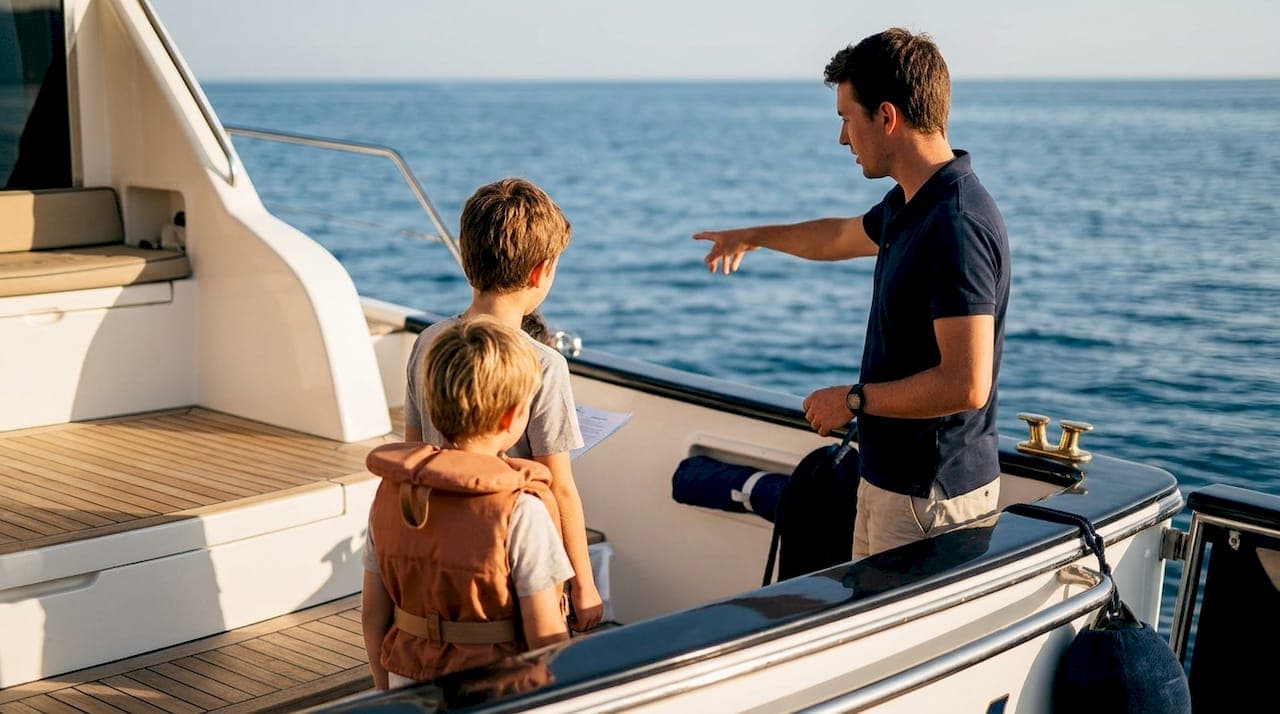
Most charters don't have a single fixed age limit: the minimum depends on the charter type. Bareboat charters usually require an adult skipper, commonly at least 18 years old, while crewed and private charters generally accept younger guests under crew supervision. Shared or cabin charters publish their own minimums, often somewhere between 5 and 18. Before booking, check the operator's minimum age clause directly and ask for written confirmation of how it applies to your group.
TL;DR:
- Small, crewed, and private charters are more flexible and often accept children and teenagers as long as proper supervision and documentation are provided.
- Bareboat charters require the skipper to be at least 18 and often need proof of sailing experience or licensing, limiting access for minors.
- U.S. safety regulations influence age policies through equipment requirements and passenger limits, but do not specify a universal age minimum.
- Confirming age policies in writing and preparing necessary documentation before booking prevents surprises and ensures smooth boarding.
- Fully crewed charters tailored for families can include customized supervision, safety briefings, and support, accommodating minors more easily than standard listings.
Table of Contents
- Age rules by charter type: bareboat, crewed, and cabin trips
- What federal safety rules mean for who can come aboard
- How to read age clauses in a charter's booking terms
- Documents and insurance for minors traveling aboard
- Flotillas, sheltered waters, and chartering abroad
- How Exotica Charters manages age policy on luxury crewed trips
- Ten steps to confirm eligibility before you book
- Booking a family charter that welcomes younger guests
- A broker's honest view on chartering with children aboard
- Sources
- FAQ
Age rules by charter type: bareboat, crewed, and cabin trips
The type of charter you choose sets the tone for every age question that follows. Bareboat charters, where guests skipper the vessel themselves, carry the strictest thresholds because the person at the helm needs a license, insurance eligibility, and often proven sailing hours. Operators commonly set the skipper's minimum age at legal adult age, often 18 or older, and some require documented experience on similar vessels before handing over the wheel.
Crewed and private charters work differently. A professional captain and crew run the boat, so the age conversation shifts from "who can drive" to "who can safely be aboard." These charters tend to be the most flexible for families, accepting infants, toddlers, and teenagers as guests, with the crew adjusting activities, safety briefings, and supervision to match the youngest person on board.
Shared and cabin charters, where unrelated groups split space on the same vessel, sit somewhere in between. Because strangers are sharing tight quarters, operators frequently publish explicit minimums, and these vary widely by company and itinerary. Day trips often have the loosest restrictions of all, sometimes welcoming any age when a parent or guardian stays within arm's reach.
A few patterns show up again and again across operator terms:
- Bareboat skippers typically need to be legal adults, often at least 18, with some operators requiring a sailing resume or certification.
- Crewed and private charters usually set no strict minimum for guests, relying instead on adult supervision ratios.
- Cabin and shared charters commonly publish fixed minimums, frequently somewhere between 5 and 18 depending on the operator.
- Day trips and short excursions tend to have the most relaxed policies, especially when a parent stays aboard the entire time.
The takeaway is simple: match your family's makeup to the charter format most likely to say yes, rather than assuming one age rule applies across the industry.
What federal safety rules mean for who can come aboard
Regulation rarely states an explicit minimum age for yacht passengers. Instead, it sets equipment and staffing requirements that operators translate into age policies of their own. The Code of Federal Regulations, Title 46, Part 25 requires vessels to carry approved life preservers and other lifesaving equipment, with specifics that shift based on vessel length and whether the boat is classified as carrying passengers for hire.
Requirements vary by vessel length and passenger-for-hire status, which is why the same size boat can face different safety obligations depending on how it operates.
That distinction between private and commercial use matters more than most charter guests realize. A vessel operating as an Uninspected Passenger Vessel, or UPV, falls under a different set of rules than one used purely for personal recreation. According to the UPV Guidebook published for the U.S. charter industry, vessels under 100 gross tons carrying up to six passengers, or larger vessels carrying up to 12 in some cases, are treated differently for inspection and operational purposes.
UPV classification determines how many passengers a vessel can carry and what supervision it must provide, which explains why "12 person" limits show up so often in charter terms and conversations.
Operators use these thresholds as practical breakpoints. A six-pack UPV, for example, might set a lower age minimum simply because the smaller passenger count means less flexibility to separate children from open decks or machinery. A larger vessel with more crew per guest can often afford to be more welcoming to families with young children, since supervision ratios are easier to maintain.
None of this means the U.S. Coast Guard hands down a specific age number. What it means is that safety equipment rules, passenger-for-hire classifications, and crew-to-guest ratios shape what an operator is willing and able to offer, and operators then write those realities into their own age policies. Reading a charter's terms with this in mind makes the fine print far easier to interpret: a strict age clause is often a safety and liability decision dressed up as a booking rule.

How to read age clauses in a charter's booking terms
Charter contracts rarely spell things out in plain language, so knowing what common phrases actually require saves a lot of back-and-forth. A clause that says "minimum age 18 unless accompanied by an adult" usually means younger guests are welcome as long as a parent or guardian is present for the entire trip, not just at embarkation. A "one adult per two minors" ratio is a supervision requirement, not a suggestion, and operators do check it at check-in.
Skipper-specific language deserves close attention on bareboat listings. Terms like "valid sailing license required" or "minimum 18 with proof of experience" mean the operator will ask for documentation before releasing the vessel, and showing up without it can end a trip before it starts.
- "Minimum age X unless accompanied by an adult" means a guardian must stay aboard for the full charter, not just at boarding.
- "Adult-to-minor ratio" clauses set a hard supervision requirement that crew or dockside staff will verify.
- "Valid license or certification required" applies to bareboat skippers and is checked before the keys change hands.
- Instant-booking platforms enforce these terms automatically, while concierge or broker-assisted bookings can often negotiate exceptions in advance.
Instant-booking platforms tend to apply these rules rigidly because there is no human reviewing your specific situation before confirmation. Concierge or broker-assisted bookings, by contrast, allow a conversation to happen before money changes hands, which is often where exceptions get made.
Pro Tip: Ask for any age-related exception in writing before final payment. A verbal "that should be fine" from a booking agent means nothing at the dock if the captain disagrees.
Red flags worth watching for include vague language like "at captain's discretion" with no stated ratio, or terms that mention age only in a cancellation clause rather than a booking clause, since that often signals the rule gets enforced inconsistently.
Documents and insurance for minors traveling aboard
Families traveling with children or teenagers should expect to gather more paperwork than a typical vacation requires, particularly when one parent is not present or when the charter crosses international waters.
- Government-issued ID for every minor, including a passport if the itinerary crosses borders.
- A certified birth certificate confirming the parent-child relationship, requested by some operators and border agents.
- Notarized parental consent when a minor travels with only one parent or a non-parent guardian.
- Signed liability waivers covering water sports, diving, and general onboard activity, standard across most crewed operators.
- Proof of travel or medical insurance that explicitly covers the minor for the charter's activities and destination.
- Emergency contact information for both parents or guardians, kept with the crew for the duration of the trip.
Insurance deserves particular attention. Operator liability coverage typically protects the vessel and crew, not necessarily the guest's medical costs, so a dedicated travel or medical policy that names the minor and covers water-based activity is worth arranging separately.
Onboard, the basics still matter most: a properly fitted lifejacket sized to the child's weight rather than age, a clear house rule on alcohol around minors, and a crew briefing at the start of the trip that covers exactly what supervision looks like for the youngest guests aboard.

Flotillas, sheltered waters, and chartering abroad
Not every body of water carries the same risk profile, and operators adjust their age policies accordingly. River charters and sheltered-water trips often set lower minimums than open-ocean itineraries, since calmer conditions and closer proximity to shore reduce the supervision burden on crew.
Flotilla charters, where multiple boats travel together with a lead vessel, frequently add their own layer of rules on top of the base charter terms, sometimes requiring a minimum age for any minor joining shore excursions unsupervised. Event-based charters, like regatta trips, can be stricter still.
Chartering outside your home country adds another variable. Local maritime authorities set their own passenger and safety rules, and what a U.S. based operator permits may not match the requirements of a charter booked abroad. It is worth confirming directly with the operator that their policy complies with the regulations of the specific country and waters you will be sailing.
How Exotica Charters manages age policy on luxury crewed trips
Exotica Charters builds every itinerary around fully crewed vessels staffed by former captains and water sports professionals, which changes the age conversation considerably compared to a bareboat or instant-booking platform. Because a professional crew runs the vessel from start to finish, the question is rarely whether a child can come aboard, but how the trip should be shaped around their age.
That typically means confirming documentation ahead of departure, arranging supervision that fits the family's needs, and briefing everyone on safety procedures before the anchor comes up.
- Pre-trip document checks confirm parental consent, ID, and insurance details before the charter begins.
- Bespoke crew arrangements can include a dedicated nanny or extra water sports support for families with young children.
- Onboard safety briefings are tailored to the age range of the group rather than delivered as a generic script.
Readers can review Exotica's guidance on why chartering suits families with children and its detailed safety briefing guide for more on how these pieces fit together before booking.
Ten steps to confirm eligibility before you book
Locking down an age policy before you pay a deposit saves everyone a stressful conversation at the dock. Work through these steps in order:
- Identify the charter type: bareboat, crewed, cabin, or day trip.
- Read the operator's published minimum age clause in full, not just the summary.
- Note any adult-to-minor supervision ratio stated in the terms.
- Confirm whether the minimum applies to guests, skippers, or both.
- Ask the operator directly whether exceptions exist for your specific group.
- Request any exception or accommodation in writing, not verbally.
- Gather required documents: ID, consent forms, and insurance proof.
- Confirm insurance covers the minor for the planned activities.
- Reconfirm the agreed terms with the operator a few days before embarkation.
- Bring printed or digital copies of every document to check-in.
Pro Tip: If an operator's stance changes at check-in despite written confirmation, ask to speak with a manager immediately and keep the original written agreement accessible on your phone.
Storing these documents in a single shared folder, accessible to every adult in your party, avoids the scramble that happens when a crew member asks for paperwork on the dock.
Booking a family charter that welcomes younger guests
Some charter companies specialize in fully crewed charters built around families, divers, and adventure travelers, handling age policy as part of planning rather than treating it as a barrier at booking. Arranging additional support such as a nanny, adjusting activity plans for younger guests, or organizing the necessary documentation ahead of departure can be part of the standard trip planning process.

For families who have found that instant-booking platforms and standard charter listings feel too rigid about age, a fully crewed, custom-planned trip offers a more workable path to the same goal: a safe, memorable trip on the water with everyone included. Explore Luxury Yachts suited to family groups, or browse Catamarans for extra space and stability with younger children aboard. When you are ready, speak with Exotica Charters about your group's ages and any documentation questions, and get a tailored quote before you commit to a date.
A broker's honest view on chartering with children aboard
Age limits in yachting exist for reasons that have very little to do with bureaucracy and everything to do with supervision ratios, equipment capacity, and who is legally responsible if something goes wrong on the water. The families who have the smoothest experience are rarely the ones who found a loophole around an age clause. They are the ones who picked a charter format built for flexibility in the first place, then did the paperwork early instead of at the dock.
If your group includes younger children or teenagers, a fully crewed charter with a professional team on board will almost always give you more room to negotiate than a bareboat or instant-booking listing ever will. Get the age policy in writing, gather your documents ahead of time, and let a crew that has done this before handle the rest.
— Mo
FAQ
How old do you have to be to charter a yacht?
There is no single industry-wide minimum age for chartering a yacht. Bareboat skippers commonly need to be at least 18 with proof of experience, while crewed and private charters often accept guests of any age under crew supervision, so the answer depends entirely on the charter type and operator terms.
What is the 12 person rule on a yacht?
The 12 person reference relates to Uninspected Passenger Vessel classification, where certain larger vessels can carry up to 12 passengers under specific operational rules described in the UPV Guidebook. This threshold affects inspection requirements and supervision ratios rather than setting a passenger age limit directly.
What is the 10 rule for yachts?
There is no widely documented "10 rule" tied to yacht passenger age or capacity in the sources covering UPV and federal safety requirements. Definitions of numeric thresholds vary by context, and the more consistently cited breakpoints are the 6 and 12 passenger thresholds described in UPV guidance.
Is a 40ft boat considered a yacht?
Yacht is a general term rather than a strict legal size category, and vessels are regulated more by passenger-for-hire classification and gross tonnage than by length alone for age and safety rules, as outlined in federal safety requirements.
Does Exotica Charters have a minimum age for guests?
Exotica Charters arranges fully crewed charters where the crew adapts supervision, safety briefings, and documentation checks to the ages of the guests aboard, rather than applying a single fixed minimum. Families are encouraged to share their group's ages when requesting a quote so the itinerary and crew arrangements can be planned accordingly.