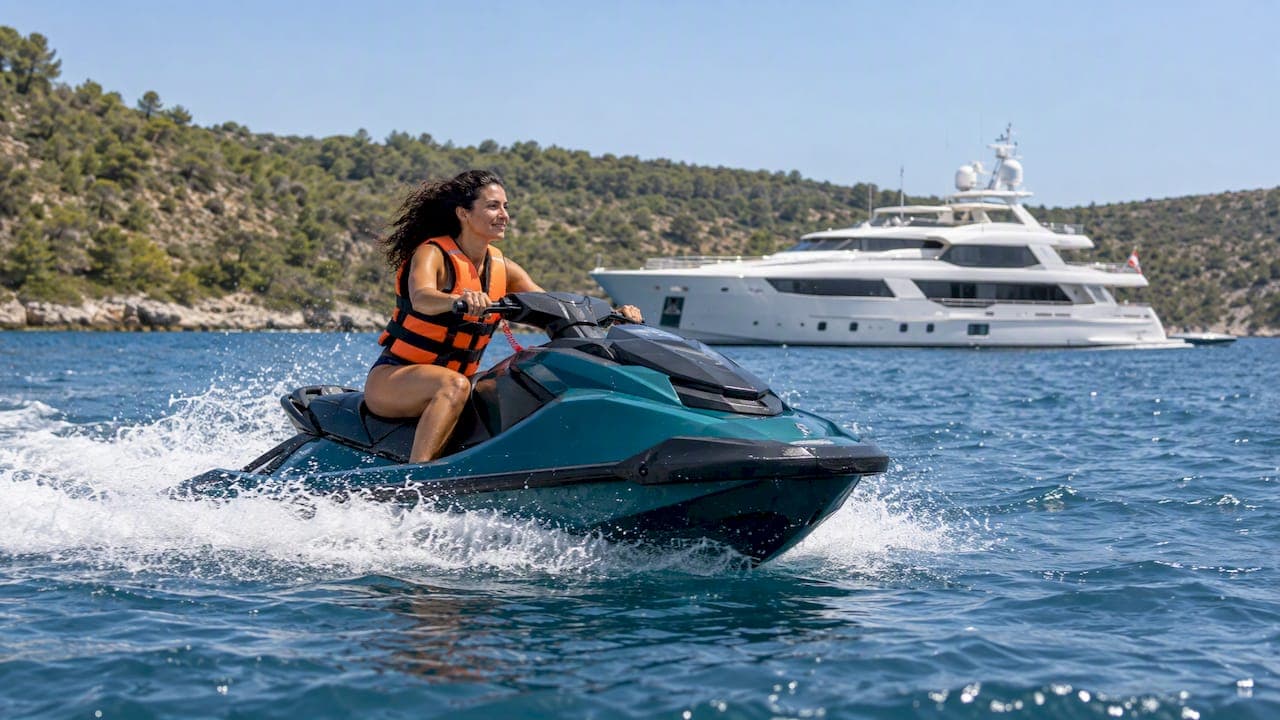
A jet ski on a charter yacht is governed by three layers of rules: federal Coast Guard rules, the law of the state or country whose waters you are in, and the captain's own onboard policy. In U.S. waters, expect everyone to wear a life jacket, the operator to wear the engine cut-off lanyard, no riding between sunset and sunrise, and a slow, no-wake approach near swimmers, docks and other vessels. Minimum ages and education requirements differ from state to state, so confirm them before you fly.
This guide explains what applies, where the rules differ, and how a well-run crew handles a jet ski day so that it stays fun for every guest.
TL;DR
- Federal rules set the floor; state law adds age limits, boating education, operating hours and distance rules, so check the state where you will cruise.
- Everyone on the jet ski wears a USCG-approved life jacket, and the operator attaches the cut-off lanyard before the engine starts.
- Most states bar personal watercraft operation between sunset and sunrise, and require headway or no-wake speed near people, docks and moored boats.
- A good crew gives a briefing, sets a riding area, keeps communications open and may send a chaser along with newer riders.
- Before booking, ask about the jet ski's use on your itinerary, the crew's briefing routine and the age policy for each rider.
Table of Contents
- How federal rules shape a charter jet ski
- State rules: the same jet ski, different laws
- Life jackets, lanyards and the gear that matters
- How a good crew runs a jet ski day
- Different guests, different experience levels
- Weather, wildlife and protected waters
- Questions to ask before you book
- Find a yacht with jet skis aboard
- FAQ
- Sources
How federal rules shape a charter jet ski
The first question the Coast Guard asks is whether the jet ski use is commercial or personal. In its bulletin on water-jet devices connected to a personal watercraft, the Coast Guard says operators must follow the Navigation Rules, that passenger-for-hire operations require at least an OUPV credential, while noncommercial personal-use leases, rentals or charters are treated as recreational operations. That distinction matters on a yacht charter, because the jet ski is usually a toy supplied to a private party, not a ride sold to the public.
The Navigation Rules themselves are not optional extras. The Coast Guard Navigation Center states that they apply to every description of watercraft used or capable of being used for transportation on water, which includes a personal watercraft. In practice that means keeping a proper lookout, staying clear of larger vessels and avoiding collision situations, even when the water looks empty.
One more federal point: the Coast Guard's recreational boating guide describes federal equipment requirements as minimums and says state requirements may add operator, education and equipment obligations. It recommends checking with the boating agency for the waters involved. Outside U.S. waters, such as on a Galápagos or French Polynesia itinerary, the local authority's rules apply instead, and your charter specialist should confirm what is permitted before you go.
State rules: the same jet ski, different laws
There is no single national age limit or licence for riding a personal watercraft. The table below shows how five popular boating states differ, using each state's own published rules.
A few patterns stand out. Night riding is prohibited in the states above that address it. Slow-speed buffers around people and structures run from 50 to 100 feet. And age rules for renting differ from age rules for operating, which is why a teenager who can ride in one state may not be able to do so in another.
Rules also change, so treat this table as a starting point and read the state agency page for your cruising area before you travel. If your itinerary crosses state lines, as many Gulf, Pacific Northwest and Northeast cruises do, the stricter rule is the safe one to follow.
Families with younger riders will find our own guide to minimum age rules on U.S. yacht charters a useful companion to this section.
Life jackets, lanyards and the gear that matters
Life jackets
The Coast Guard recommends that everyone aboard wear a USCG-approved personal flotation device, and notes that required equipment must be USCG-approved or certified. On a jet ski, state law usually turns that recommendation into a requirement for every rider. Texas goes further and says inflatable life jackets are not approved for personal watercraft use, so a comfortable inflatable you wear for paddleboarding is not the right choice here.
On a well-equipped yacht, the crew should have properly sized, approved jackets in every range from children to large adults. Ask to try yours on at the briefing rather than on the swim platform with a jet ski idling beside you.

The engine cut-off lanyard
The cut-off link is a cord that connects the operator to the engine switch. If the rider falls or is thrown off, the engine stops. The Coast Guard explains that the link shuts off the engine if the operator is displaced from the helm, helping prevent runaway vessels. Its rule, in effect since April 1, 2021, covers recreational vessels under 26 feet with engines capable of at least 115 pounds of static thrust, with the link used on plane or above displacement speed unless the main helm is in an enclosed cabin. The same notice says 44 states have laws covering the use of the link on personal watercraft.
The habit is simple: attach the lanyard to your life jacket or wrist before you press start, and detach it only when you are back on the platform. Texas and North Carolina both specifically require a fitted lanyard to be attached to the operator or their clothing.

How a good crew runs a jet ski day
Rules on paper are only half the story. The other half is how the crew organizes the day. The Coast Guard's water-jet device bulletin recommends that operators set procedures for briefings, communications, emergency recovery, quick releases, weather and sea-state limits, traffic and obstructions, and consider an additional person or chase boat. Those headings are a good checklist for what you should see on your charter.
The briefing
A useful briefing is short, specific and delivered before anyone touches the throttle. It should cover:
- How to start, steer and stop, and how the lanyard works.
- Where you may ride, marked by a clear boundary the crew can see from the yacht.
- Speed limits near the yacht, swimmers, snorkelers and other boats.
- What to do if you fall off: stay with the machine, signal, wait for the crew.
- Hand signals or radio channels for "I'm fine", "I need help" and "come back".
The Coast Guard's bulletin recommends a passenger safety briefing covering communications, passenger controls, permitted and prohibited operations and safety-equipment use, and clear two-way communication for two-person operations. Our yacht charter safety briefing guide walks through what to expect at the start of any charter, including water toys.
Supervision and communications
A well-run charter keeps a crew member watching the riders at all times, with a tender or chase craft ready to reach anyone in trouble. For first-time riders, an escorted first ride is common sense. If the yacht carries VHF radio, the Coast Guard says a vessel should maintain a watch on channel 16 when the radio is not being used, with additional requirements for specified larger or commercial vessels. Ask your captain how riders will reach the bridge if something goes wrong: handheld radio, waterproof signal device or a spotter on the platform.
Keeping swimmers and divers apart from machines
Jet skis and swimmers should never share the same patch of water. The sensible approach is a separate riding zone, well away from the swim platform, the snorkeling area and any dive site. Where diving is part of your trip, the Coast Guard notes that although recreational diving itself is not Coast Guard-regulated, the licensed master of a commercial passenger vessel carrying divers remains responsible and accountable for vessel and passenger safety. The same document recommends briefing divers, regardless of experience, on responsibilities, site hazards, communications, emergency procedures and expected conditions before they enter the water. On a dive charter, that means the crew sequences activities: divers in the water, jet skis stay on deck.
Different guests, different experience levels
A charter party rarely rides at one level. A veteran rider, a nervous teenager and a grandparent who has never touched a throttle may all want a turn. A few principles keep everyone comfortable:
- Match the ride to the rider. Newer riders do best in a sheltered bay with a crew member nearby, not in an open channel with chop.
- Respect age rules without negotiation. Age limits are set by the state, and a captain who follows them protects both guests and the charter.
- Offer alternatives. A tender ride, snorkeling, paddleboarding or a guided shore excursion can be just as memorable for guests who prefer to stay out of the saddle. If you like wind-driven sport, resources such as this look at kitesurf spots on Elba show how destinations often pair different water sports.
- Keep alcohol off the machine. Texas, for example, specifically prohibits intoxicated operation. Save the sundowner for after the last jet ski is secured.
Guests who also want to dive, fly a camera or ride a helicopter into the snow have other rules to consider. Our guides to drone rules on yachts and heli ski yacht planning cover those, and our overview of yacht charter etiquette explains how to be a good guest in general.
Weather, wildlife and protected waters
The best jet ski day starts with a forecast. The Coast Guard Boating Safety Division says boaters should check weather before departure, watch for changing conditions and act accordingly, wear life jackets and leave a float plan with a responsible person. On a crewed yacht, the captain handles the float plan, but you should still ask about wind and sea-state limits for the day, and expect to be told "not today" when conditions turn.
Protected areas add another layer. NOAA says each person entering a marine protected area should plan around special rules and restrictions, weather, tides and other natural conditions, and its Monterey Bay sanctuary page on motorized personal watercraft is an example of how specific those rules can be. Some national parks, sanctuaries and wildlife areas restrict or ban personal watercraft altogether. If your trip is built around wildlife, such as whales, turtles or seabirds, assume the jet ski may have to stay on deck in the best viewing areas, and trust your captain's local knowledge.
Questions to ask before you book
When you compare charters that carry jet skis, these questions separate an experienced operation from a casual one:
- Is the jet ski use personal and noncommercial, or is it sold as a ride? The Coast Guard treats the two differently, with credential requirements for passenger-for-hire operations.
- What is the minimum rider age in the waters on my itinerary? Ask for the specific state or country rule.
- How is the briefing delivered, and who gives it? A crew member with water sports experience is a good sign.
- How are riders supervised? Look for a spotter, a chase option or a defined riding zone.
- How do riders communicate with the yacht? Handheld radios or agreed signals.
- What are the weather and sea-state limits for riding?
- Do the protected areas on my route restrict motorized water toys?
- How many jet skis are aboard, and are life jackets provided in all sizes?
If a charter cannot answer these clearly, it is worth finding one that can.
Our perspective
We came to charter from the water: our team is made up of former captains and water sports professionals, and we have run enough jet ski days to know that the rules are the beginning, not the end, of a safe one.
The best days we have seen share a pattern. The briefing is short and specific, the riding zone is obvious, someone is always watching, and the guests who would rather not ride are given something just as good to do. Nobody feels rushed, and nobody feels left out.
That is why we match guests with yachts rather than simply listing them. A yacht with a capable crew, the right toys and a captain who knows the local rules will always deliver more adventure than one with a longer equipment list. When you tell us who is traveling, their ages and how confident they are on the water, we can point you to the vessel and itinerary that fit.
Mo
Find a yacht with jet skis aboard
If you are ready to plan, we can help you choose a crewed yacht where jet skis are part of the toy box, and where the crew is set up to run them well. Browse our charter yachts with a jet ski, or look at yachts carrying multiple jet skis if your group wants to ride together.

Tell us your dates, who is traveling and what you want to do on the water, and a yacht charter specialist will shape an itinerary around it. Start at Exotica Charters and speak to a specialist about your trip.
FAQ
Do I need a licence to ride a jet ski on a yacht charter?
There is no federal personal watercraft licence, but some states require boating education. Florida, for example, requires a Boating Safety Education ID Card for operators born on or after January 1, 1988, on vessels of 10 horsepower or more. Your crew should explain what applies in the waters you are visiting.
Can children ride a charter yacht's jet ski?
It depends on the state. Ohio generally bars operators under 16, with supervised exceptions for ages 12 to 15, and Florida sets 14 as the operating age. Many families choose to let younger children ride as passengers with an adult, where the law allows, or enjoy a tender ride instead.
Can we ride a jet ski at night or at sunset?
Generally no. Ohio, Texas and North Carolina all prohibit personal watercraft operation between sunset and sunrise, or at night. Plan your riding for the middle of the day, when visibility is best.
Are jet skis allowed near wildlife or in marine protected areas?
Often they are restricted. Protected areas can carry their own rules on motorized personal watercraft, and some ban them entirely. Ask your charter specialist before booking if wildlife or snorkeling is central to your trip.
Sources
- Marine Safety Information Bulletin on water-jet devices, U.S. Coast Guard
- Navigation Rules Frequently Asked Questions, USCG Navigation Center
- A Boater's Guide to the Federal Requirements for Recreational Boats, USCG
- New law requiring use of engine cut-off switches, USCG
- Vessels FAQ, Florida Department of Highway Safety and Motor Vehicles
- Ohio Boat Operating Laws, Ohio DNR
- Personal Watercraft Operation and Regulations, Texas Parks and Wildlife
- G.S. 75A-13.3, North Carolina General Statutes
- Boating laws, rules and license requirements, California State Parks
- Recommendations of Recreational Diving Operations, U.S. Coast Guard
- Motorized Personal Watercraft, Monterey Bay National Marine Sanctuary, NOAA
- Elba kitesurf: dove andare e perché sceglierla