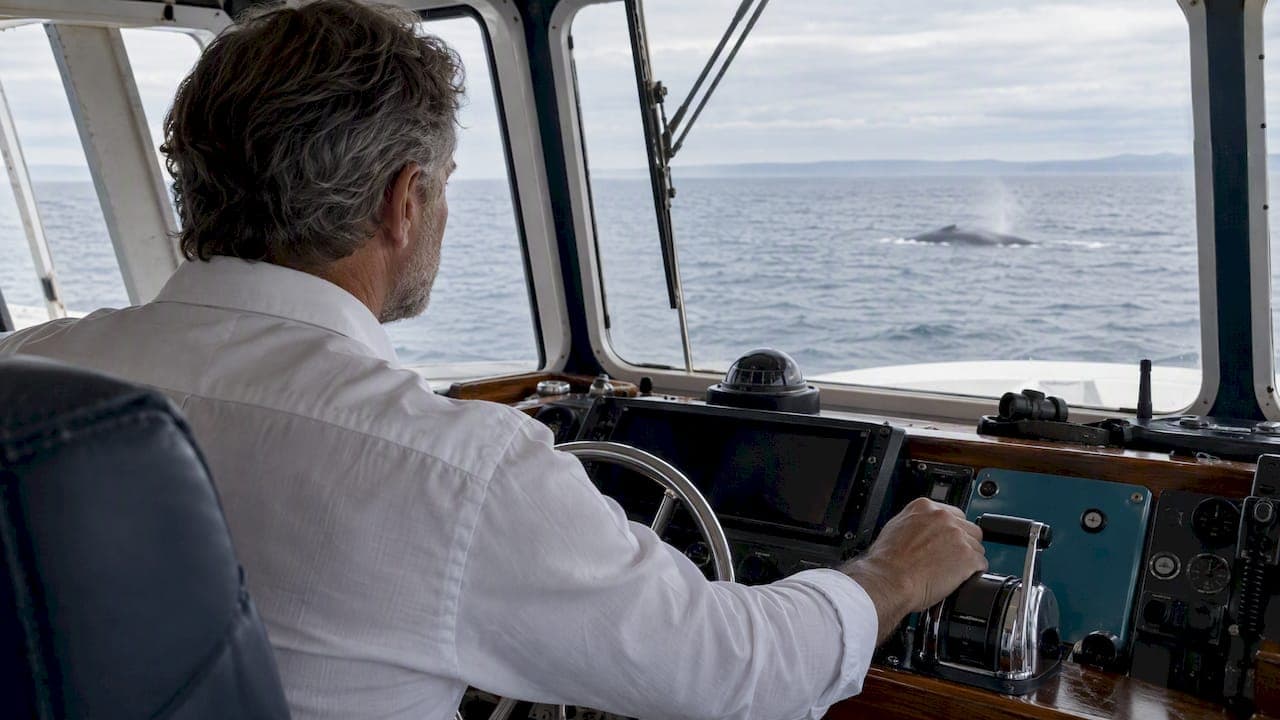
An ethical wildlife encounter on a charter is one where the animal sets the terms. You keep your distance, move slowly, never feed or touch, and leave the moment an animal shows it would rather you did. The rest is detail: which distances apply where, how to behave in the water, and how to judge whether your captain and guides will hold to those standards when a pod of dolphins is tempting you to get closer.
A private yacht gives you something a crowded tour boat cannot: time, flexibility and the ability to walk away. That freedom is also the risk. Nobody else is watching, so the standard is whatever your crew and you decide it is. Here is how to set it high.
TL;DR
- Stay at least 100 yards from large whales and 50 yards from dolphins, porpoises, seals, sea lions and turtles in U.S. waters, with larger buffers for some species (NOAA Fisheries).
- Never feed, chase, touch, ride or encircle wildlife, from the yacht, the tender or the water.
- Limit any single viewing to 30 minutes or less, and leave slowly when animals show signs of disturbance.
- Choose a crew that briefs guests, includes trained naturalists or guides, and has the authority to say no to a guest who wants a closer look.
- Agree on the rules before you board, not when the whales appear.
Table of Contents
- What "ethical" actually means on the water
- Distances to know before you sail
- How the yacht should behave
- In the water: snorkeling and diving etiquette
- Practices that should make you walk away
- What to ask before you book
- Where the best encounters happen without pressure
- Our perspective
- Plan a charter built around respectful wildlife time
- FAQ
- Sources
What "ethical" actually means on the water
The phrase can sound vague, but the international guidance is specific. The Convention on Migratory Species describes an acceptable encounter as one that is permitted for the species, place and time, that does not interrupt feeding, resting, mating, nursing or other important behavior, and that stays nonintrusive. It adds a clear stop rule: end the interaction if the animal avoids you, becomes agitated, or is injured or entangled (CMS international guidelines for sustainable marine wildlife watching).
Two ideas sit under that definition.
The animal decides. IAATO's guidance for vessels and Zodiacs says the animal should dictate the encounter. Crews stop, slow or steer away to avoid collisions, never chase, and retreat slowly and quietly when animals show disturbance. Because reading animal behavior is hard, the same guidance stresses experienced officers and naturalists, and says that when you are unsure, the safest default is to give wildlife more time and space (IAATO marine wildlife watching guidelines).
Small disturbances add up. The Glacier Bay National Park Science Advisory Board has raised the concern that apparently minor, repeated vessel disturbances can accumulate into meaningful biological effects (Glacier Bay Science Advisory Board report). One yacht lingering for ten extra minutes may seem harmless. The same behavior repeated by every vessel in a season is not. Ethical viewing means thinking about the whole season, not only your own morning.

Distances to know before you sail
For U.S. waters, NOAA Fisheries gives the baseline: at least 100 yards from large whales and 50 yards from dolphins, porpoises, seals, sea lions and turtles. Some species and places carry larger buffers (NOAA marine life viewing guidelines).
| Species or place | Minimum distance from vessels |
|---|---|
| Large whales (general) | 100 yards |
| Humpbacks in Hawaiʻi and Alaska | 100 yards |
| Dolphins, porpoises, seals, sea lions, turtles | 50 yards |
| Killer whales, Washington State inland waters | 200 yards |
| North Atlantic right whales, U.S. waters | 500 yards |
Hawaiʻi adds finer detail. NOAA's Hawaiʻi guidance recommends viewing sea turtles from 10 feet, other whales and dolphins from at least 50 yards, and Hawaiian monk seals from about 50 feet, using the thumb-cover rule to judge it (NOAA Hawaiʻi viewing guidelines). It also advises against swimming with wild spinner dolphins, because they rest and nurse their young during the day.
Seasonal rules matter as much as distances. In Glacier Bay, harbor seals show strong site fidelity during pupping in May and June and molting in August, and special speed and distance regulations apply in Johns Hopkins Inlet from May through August (National Park Service). Those rules are exactly the kind of thing a seasoned captain should raise during planning, not something you discover on the day.
Outside the United States, local authorities set their own limits. Ask your charter specialist which rules govern your itinerary, and treat the stricter of any two standards as your own.
How the yacht should behave
Most disturbance starts at the helm, not in the water. The practical rules from NOAA and the Monterey Bay National Marine Sanctuary are straightforward:
- Slow down early. Reduce speed to 10 knots or less near whales, and run at no-wake speed or the speed of the slowest whale in the group. If a whale is within 300 feet (100 yards), stop the vessel (Monterey Bay National Marine Sanctuary).
- Approach from the side, not head-on. Observe from one side, never drive through a group, and put the engines in neutral when a nearby whale is feeding or resting.
- No chasing, encircling or trapping. Also no wake-riding setups, and never separate a mother from her calf.
- Cap the time. NOAA and the sanctuary both recommend 30 minutes or less with an individual or group.
- Leave slowly. Signs of disturbance mean you ease away, not that you take one more photo.
Monterey Bay treats collision risk, engine noise, speed, sudden maneuvers and the cumulative presence of vessels as linked harms rather than matters of etiquette. The International Whaling Commission makes a similar point: vessel design, maintenance, speed, sound and the number of nearby boats all influence disturbance, and quieter operation with fewer vessels reduces pressure on animals (IWC general principles for whale watching).
If you want the mechanics of slow-speed operation in plain terms, the rules for no wake zones are a useful primer on why a posted number is not always the whole story. In wildlife work, the right speed is the one the animals tolerate, which is often slower than any sign requires.
In the water: snorkeling and diving etiquette
The tender and the dive deck are where good intentions most often slip. The rules are consistent across agencies.
Do not interact. NOAA's guidance is not to swim with, ride, touch or attempt to interact with marine mammals or sea turtles, and not to touch corals or other animals (NOAA Fisheries).
Control your body. The Great Barrier Reef Marine Park Authority advises divers and snorkelers to manage buoyancy, secure dangling equipment, move slowly, avoid sudden or loud movements, never touch reef or animals, avoid feeding fish, and never chase, ride, grab or block free-swimming animals. It also asks you to stay more than one meter from giant clams, avoid stirring up sand, and never relocate marine life for a photograph (Reef Authority responsible reef practices).

Be predictable. Where permitted in-water encounters do happen, the IWC and CMS recreational-interaction guidance asks participants to swim calmly and predictably, and to avoid chasing, cornering, pursuing, unnecessary noise and sonic signalling (IWC recreational in-water interaction guidelines).
Diving with a guide who knows the animals
A good dive briefing covers more than depth and air. It covers what you will not do: no touching, no cornering a shy animal for a better angle, no hovering over a nesting site. A guide with marine-biology training can read behavior and call the dive, which is why we often suggest bringing a marine biologist along on a charter dive. The best dives we hear about are the ones where guests surfaced saying how much they saw by doing less.
Families and first-time snorkelers
The questions with young children are practical. Keep the group small, put the most confident swimmer beside the least, and rehearse the rule before anyone enters the water: hands stay to yourself, always. Children find it natural to want to touch a turtle or follow a fish, so give them a job, such as counting species or spotting behavior, that keeps their attention on observation. Pick the calmest, shallowest site for the first swim, and let anyone sit out a swim without fuss; a rushed or reluctant swimmer is the one most likely to kick coral.
Divers should check certification limits and local permit conditions for any in-water encounter with protected species. Ask the crew to confirm both before you pack.
Practices that should make you walk away
Ground the checklist in what the agencies say causes harm. Be wary of any operator or crew who proposes:
- Feeding or baiting animals so they come to the boat. CMS strongly recommends against direct feeding and urges extreme caution about intentionally attracting wildlife.
- Guaranteed touches, rides or "swim with" promises for wild marine mammals or turtles.
- Chasing a pod to get you into position, or boxing animals between vessels.
- Playing recorded sound to draw animals in.
- Moving animals, such as picking up a starfish or relocating a creature for a photo.
- Staying well beyond half an hour because the sighting is good.
- Crowding in alongside several other boats at the same sighting.
None of these is a gray area in the guidance. If a captain suggests any of them, you are entitled to say no, and a good crew will agree.
What to ask before you book
The CMS guidelines point to the markers of a responsible operation. Turn them into questions:
- Are you authorized where authorization is required? CMS recommends dedicated permits for commercial in-water interactions, with specific authorization.
- Who briefs guests, and when? Rules explained at the dock are better than rules explained once the whales are alongside.
- Who reads the animals? Ask about trained guides or naturalists on board. We cover this on our page about naturalists and expedition guides.
- How do you limit time and vessel numbers? The answer should include a time cap and willingness to leave a crowded sighting.
- Do you follow local agency guidance? The answer should name the agency for the region you are visiting.
- What happens if an animal shows disturbance? The right answer is that the vessel slows, steers away and gives space, without negotiation.
A private charter lets you ask these questions of one captain and one crew, rather than hoping a large tour operator applies the same standard on every departure.
Where the best encounters happen without pressure
The places that reward patience are often remote, where animals are less used to vessels and viewing pressure is lighter. That is part of why we plan around destinations such as the Galápagos, French Polynesia and Alaska.
- In the Galápagos, guided landings and naturalist-led viewing keep the pace slow. Our Galápagos wildlife watching guide and the page on naturalist yacht charters explain how those days are structured.
- In French Polynesia, humpback season rewards guests who accept fewer crowds and strict rules; we wrote about it in humpback season in French Polynesia.
- In Alaska, knowing which orca ecotypes visit which waters helps you plan sensibly. See our orca season guide for Alaska.
- If whales are the draw, our whale watching destinations roundup compares regions by season.
If photography is the point of your trip, the same principles apply to the lens: ethical wildlife photography on the water is about long lenses and patience, not a closer approach.
For a sense of what you can reasonably expect to see, our page on wildlife on an expedition charter is a good starting point.
Our perspective
Our team is made up of former captains and water sports professionals, and we have stood where you will stand: at the helm, with guests excited, a whale surfacing a little closer than planned, and a decision to make. In that moment, the right call is almost always the unglamorous one. Throttle back, hold your position, let the animal choose.
We would suggest treating wildlife time as a gift rather than an entitlement. The most memorable encounters tend to be the ones that happen to you: a humpback passing at a comfortable distance, a turtle drifting by a still snorkeler. When guests let go of the idea of getting close, they usually get more from the day.
We also think the choice of yacht and crew shapes the outcome more than any rule sheet. A well-handled vessel with quiet engines and a captain who has the confidence to say "not today" does more for the animals than any brochure promise. That is why we match each itinerary to the right crew and ask about wildlife practices early. Our overview of how responsible and sustainable expedition charters are explains how we think about it.
— Mo
Plan a charter built around respectful wildlife time
If you are weighing a trip to a remote destination for diving, whales or birdlife, we can help you choose the vessel, the season and the crew that fit how you want to travel. Exotica Charters plans fully crewed motor yachts, sailboats, catamarans and expedition vessels, with itineraries shaped around your interests and the rules of each region. Speak to a yacht charter specialist through our charter collection and tell us what you hope to see.
If you are comparing vessel types, you can also browse motor yachts, catamarans and sailboats, or read about what crew is on board an expedition charter.
FAQ
How close can a yacht get to whales and dolphins?
In U.S. waters, NOAA Fisheries recommends at least 100 yards from large whales and 50 yards from dolphins, porpoises, seals, sea lions and turtles. Some species have larger buffers, such as 500 yards for North Atlantic right whales. Local rules abroad differ, so confirm them for your route.
Is it ethical to swim with wild dolphins or whales?
NOAA advises against swimming with, riding, touching or trying to interact with marine mammals and sea turtles. In Hawaiʻi, spinner dolphins rest and nurse during the day, so swimming with them is discouraged. Where a permitted in-water program exists, it should be authorized and tightly managed.
How long should we stay with an animal?
NOAA and Monterey Bay National Marine Sanctuary both recommend limiting observation of an individual or group to 30 minutes or less. If animals move away or change behavior, end the encounter earlier.
What should I ask a charter company about wildlife practices?
Ask whether the crew is authorized where required, how guests are briefed, who on board can read animal behavior, and how time and vessel numbers are limited. Also ask whether they prohibit feeding, touching, playback and pursuit.
Can divers and families take part safely and respectfully?
Yes, with preparation. Control buoyancy, keep equipment secured, avoid touching anything, and keep groups small with a guide. Children should have a simple rule to follow and the option to sit a swim out.
Sources
- NOAA Fisheries: Marine Life Viewing Guidelines
- CMS: International Guidelines for Sustainable Marine Wildlife Watching
- Glacier Bay National Park Science Advisory Board report
- IAATO Marine Wildlife Watching Guidelines for Vessels and Zodiacs
- NOAA: Marine Wildlife Viewing Guidelines for Hawaii
- National Park Service: Twenty-six Years of Monitoring Glacier Bay Harbor Seals
- Monterey Bay National Marine Sanctuary: Whale Watching Guidelines
- IWC: General Principles for Whale Watching
- Great Barrier Reef Marine Park Authority: Responsible Reef Practices
- IWC and CMS: Guidelines for Recreational In-Water Interactions