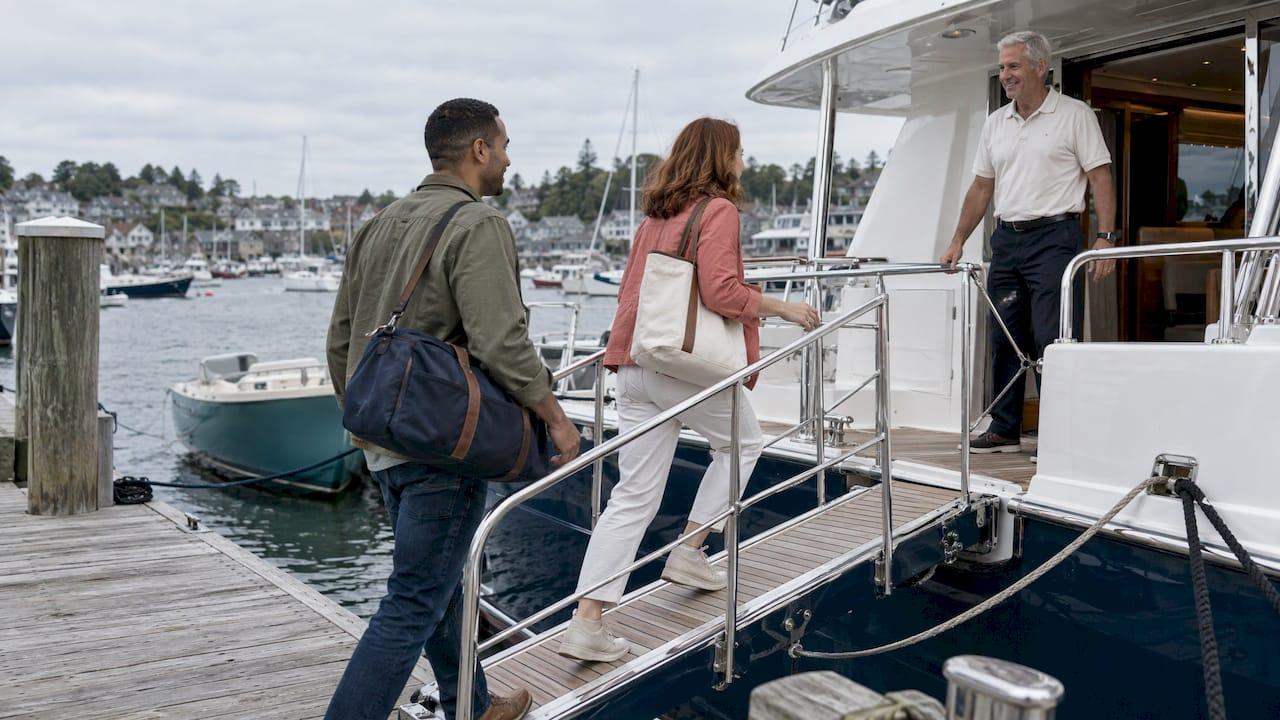
To charter a yacht, you choose a crewed vessel that fits your group, work with a specialist charter broker who knows the yachts and the destination, agree a budget that includes expenses on top of the base fee, and then sign the contract and prepare for departure. For a first charter in remote waters, a fully crewed yacht arranged through experienced specialists is the simplest path: a professional captain and crew handle navigation, safety and service, so you spend your days diving, watching wildlife or simply anchored somewhere extraordinary.
We are a team of former captains and water sports professionals, and we plan fully crewed charters to places such as the Galápagos, French Polynesia and Alaska. This guide walks through each step in the order you will meet it, and shows where first-time charterers most often go wrong.
TL;DR
- A fully crewed charter, with a captain and crew aboard, is the easiest way to charter if you do not sail yourself; bareboat means you run the yacht.
- Work with a charter broker who matches you with a yacht and crew and leads the planning, then give them detailed preferences.
- Budget for expenses on top of the base fee: roughly 30 percent for food, fuel and dockage through an APA, plus a crew tip.
- Choose the yacht by who is traveling and how much time you will spend aboard versus ashore, not by size alone.
- Before you sign, confirm what is included, the crew's specialties, the equipment aboard and your insurance.
Table of Contents
- Crewed or bareboat: the first decision
- Step 1: Decide who is traveling and what you want to do
- Step 2: Work with a specialist charter broker
- Step 3: Choose the type of yacht
- Step 4: Build the budget, including what is not in the base fee
- Step 5: Ask the right questions before you commit
- Step 6: Contract, payment and preparing for departure
- Matching the destination to your trip
- Start your charter with specialists who have worked the water
- Our perspective
- FAQ
- Sources
Crewed or bareboat: the first decision
The words describe who operates the boat. On a bareboat charter, you and your guests sail the yacht yourselves. On a skippered charter, a professional skipper sails it, and a fully crewed charter may add a host or chef, as The Boston Globe explains. The same article notes that skippered charters suit people without sailing experience, or those who are not comfortable navigating unfamiliar waters.
For the travelers we work with, the choice is rarely close. Divers want to think about the reef, not the anchor. Families want a captain who knows which bay is calm for children. Couples heading somewhere remote want service and privacy, not a watch rota. Remote destinations also reward local knowledge: anchorages, weather windows and wildlife encounters are far easier when the person at the helm has worked those waters before.
A crewed charter is the choice we recommend for nearly every trip in this guide. If you want to see how the styles differ in practice, our overview of yacht charter types lays out which style of charter fits which trip.
Step 1: Decide who is traveling and what you want to do
Before you look at a single yacht, write down three things: who is coming, how long you have, and what the trip is for. AFAR's planning guide advises choosing a yacht by who is traveling and how much time you expect to spend aboard versus ashore, because that determines how much cabin and living space you will actually use. Extra space costs more, so it pays to be honest about it.
A few examples show how this plays out:
- A couple on a remote getaway often spend the day in the water or on shore and need a comfortable cabin, a good deck and a crew that gives them room.
- A family with young children needs stable, spacious living areas and a crew comfortable with children.
- A group of divers needs dive equipment, a crew that understands dive logistics, and an itinerary built around the sites rather than around distance.
- Wildlife enthusiasts need an itinerary with time at anchor and flexibility to follow what the animals do.
Two details help you size the group. The Boston Globe reports that most of the charter yachts it discusses have three or four cabins, suited to groups of six to eight, and that a skipper may use one of those cabins on a skippered boat. Our guide to yacht charter guest capacity explains how cabin count and guest numbers relate, and you can browse 4-cabin yachts and 6-cabin yachts once you know your group size.
Step 2: Work with a specialist charter broker
A charter broker matches you with a yacht and crew and leads the planning. Condé Nast Traveler's beginner's guide describes that role, and advises sharing detailed preferences: dietary requirements, likes and dislikes, and the activities you want. If you can, it suggests finding a broker through a friend's recommendation.
In practice, the quality of a charter depends on how much the person planning it knows about the yachts and the destination. A broker who has worked as a captain can tell you which boats handle a long crossing well, which crews are strong with diving or with children, and how to pace an itinerary so you are never rushed. That is the thinking behind our team: we are former captains and water sports professionals, so we plan from experience on the water.
What to give your broker:
- Dates and flexibility. Remote destinations have seasons. Tell us your ideal dates and how far they can move.
- Guest list. Ages, mobility, swimming and diving experience.
- Priorities. Diving, wildlife, water sports, relaxation, food. Rank them.
- Food and drink. Allergies, preferences, favorite wines, celebrations.
- Budget. A realistic all-in figure, including expenses, so the shortlist is accurate from the start.
Step 3: Choose the type of yacht
Crewed charters come in several forms, and each suits different priorities.
| Yacht type | Suits | What to expect |
|---|---|---|
| Catamaran | Families, mixed groups, first-timers | A stable platform with generous shared space |
| Sailboat | Couples, travelers who enjoy sailing | Quieter passages under sail, a classic feel |
| Motor yacht | Groups wanting speed, space and amenities | Covers distance comfortably, often with more toys and deck space |
| Luxury and larger yachts | Larger parties, special occasions | More crew, more cabins, more service |
| Expedition vessels | Remote, polar or wildlife-focused trips | Built for long range and rough or cold waters |
The Boston Globe quotes a sailing expert who recommends catamarans for groups with non-sailors or young children, because they can be a more comfortable platform than a heeling monohull. For polar or expedition waters, the question changes to what makes a vessel suitable there, which we cover in what makes a yacht suitable for polar or expedition waters.
The type of yacht also shapes the type of crew. If you want to know who works on an expedition charter, see what crew is on board an expedition charter. Crew make or break the trip; on a good boat they are the reason guests rebook.
Step 4: Build the budget, including what is not in the base fee
The base charter fee is only part of the cost. Condé Nast Traveler's guide cites an entry point of around $40,000 for a week on a yacht of 82 feet or more that sleeps six. That is a reported starting point rather than a rule for every market, and costs vary widely with yacht type, season and destination.
On top of the base fee, plan for:
- Food, beverages, fuel and dockage. These are usually paid through an Advance Provisioning Allowance, or APA, a deposit the crew draws on during the trip and reconciles with you at the end. The same guide suggests budgeting about 30 percent for these costs. AFAR puts extras at about 30 percent above the base price as well, and lists food, drinks, fuel, marina fees, park fees and taxes as possible additions.
- Taxes. VAT may apply depending on the country where you embark.
- Crew gratuity. A tip of 10 to 20 percent of the charter fee is the guideline in Condé Nast Traveler's guide.
A worked example makes it concrete. If a base fee is $40,000 and you budget 30 percent for expenses, set aside about $12,000 more, bringing the trip to about $52,000 before taxes and a tip. A 10 percent tip on the base fee would add $4,000. Treat these as a planning illustration, not a quote.
For detailed figures by yacht type, see what an expedition yacht charter costs, our catamaran charter cost breakdown and the short answer on how much an expedition charter costs. Give your broker your all-in number first and ask for yachts that fit it, rather than choosing a yacht and discovering the real total later.
Step 5: Ask the right questions before you commit
The shortlist is where details matter. Robb Report's guide advises asking what expenses are included, requesting crew references, and checking that the crew's specialties and service fit your group. It also recommends asking about cabin configuration, yacht features and equipment, and liability and trip-cancellation insurance.
Turn that into a short list:
- What is included in the fee? Fuel, water toys, dive gear, park fees, alcohol, shore excursions.
- Who is the crew? Experience in your destination, and strengths that match your trip: family-friendly service, watersports instruction or a talented chef.
- Can we speak to past guests? Robb Report quotes a charter consultant who recommends crew references before final selection.
- What is actually aboard? AFAR notes that water toys may include snorkel and dive equipment, paddleboards, kayaks, personal watercraft and tenders, and recommends confirming what is aboard before booking. Divers should confirm tanks, compressor access and certified dive staff.
- How are the cabins laid out? Two couples may want two doubles; a family may want connecting cabins.
- What happens if plans change? Ask about cancellation terms and about insurance for the trip.
Do not choose on price alone. A less expensive yacht with the wrong crew or the wrong layout can cost you far more in enjoyment than it saves.
Step 6: Contract, payment and preparing for departure
Once you have chosen a yacht and dates, your broker presents a charter contract. It sets out the dates, base fee, what is included, the APA arrangement and the cancellation terms. Payment is typically made in stages, so read the schedule and note the due dates. Confirm any insurance you plan to take out at this point, as advised in Step 5.
Then you prepare for the trip itself:
- Travel documents. Passports and any entry requirements for the country where you embark. Remote regions may have their own permit or park rules; your broker should tell you what applies to your itinerary.
- Preference sheet. The crew uses it to plan menus, drinks, activities and cabin set-up. The more specific it is, the better the first dinner on board.
- Packing. Soft-sided bags store easily, and layers matter in cooler regions such as Alaska. Divers should bring certification cards and any personal equipment they prefer.
- Celebrations. If you are marking an anniversary or birthday, tell the crew early. Ideas like these champagne reception ideas can help you plan a toast on deck at sunset.
On arrival, the captain gives a safety briefing and reviews the plan. From there, the itinerary is flexible: the best charters adjust to weather, wildlife and the mood of the group. Our article on yacht itinerary planning explains how a good itinerary keeps guests engaged without overscheduling them.
Matching the destination to your trip
The best charter starts with what you most want to experience.
Divers. Choose destinations known for underwater life and a yacht equipped for it. A crew that includes water sports professionals is a real advantage, since diving logistics shape the whole day.

Wildlife enthusiasts. The Galápagos, Alaska and other remote regions reward flexible itineraries and time at anchor. A yacht that can reach quiet bays gives you encounters that day trips cannot. Expedition-style vessels are built for this; see what activities there are on an expedition charter.
Families. Look for calm anchorages, stable yachts, water toys and a crew that enjoys children. A catamaran often works well, and an itinerary with short hops keeps everyone fresh.
Couples. Remote anchorages, private beaches and a crew that knows when to step back. French Polynesia and similar destinations suit this style of trip.
If you are weighing a yacht against a cruise ship for a trip like this, our piece on choosing a yacht versus a cruise sets out the difference.
Start your charter with specialists who have worked the water
We plan fully crewed yacht charters, from sailing yachts and catamarans to motor yachts, superyachts and expedition vessels, to remote destinations around the world. Tell us who is traveling, when and what you hope to experience, and we will build the itinerary and shortlist around it. Explore the options on Exotica Charters and speak to a yacht charter specialist.
If you already know you want a crewed vessel, start with our crewed yacht charters.
Our perspective
Most first-time charterers worry about the wrong things. They fret over yacht length and brand names, when the trip is made by the crew and the itinerary. A captain who has spent years in a destination knows where the water is clear, where the wildlife gathers and when to leave an anchorage before the wind changes.
That is why we are built the way we are. Our team are former captains and water sports professionals, and we plan each charter the way we would want ours planned: around what you want to do, who is coming, and the realities of the water. We would suggest starting with a conversation about your priorities rather than a list of yachts.
Remote places are the heart of what we do. The Galápagos, French Polynesia and Alaska are not destinations to improvise, and a fully crewed yacht lets you reach them in comfort with people who know them.
Mo
FAQ
How far in advance should I book a yacht charter?
For remote destinations and peak seasons, the earlier the better, because the most sought-after yachts and crews fill first. Your broker can tell you the season for your destination and how much flexibility your dates have. Contact us as soon as you have a rough window in mind.
Do I need sailing experience to charter a yacht?
Not on a crewed charter. A professional captain and crew operate the yacht, and the Boston Globe notes that skippered options suit people with no sailing experience. You only need to tell the crew what you would like to do.
What is an APA on a yacht charter?
APA stands for Advance Provisioning Allowance. It is a deposit, paid with the charter fee, that covers food, drinks, fuel and dockage during the trip. Condé Nast Traveler suggests budgeting about 30 percent for these costs, and any unspent balance is reconciled at the end of the trip.
Should I tip the crew?
Tipping is customary on crewed charters. Condé Nast Traveler gives 10 to 20 percent as a guideline. Tips are usually handed over at the end of the trip, shared among the crew.
Can I charter a yacht for a family with young children?
Yes. Choose a stable yacht, often a catamaran, and a crew that is comfortable with children, and tell your broker the children's ages when you start planning. Calm anchorages and water toys help keep younger guests happy.
Sources
- How to Charter a Yacht: A Beginner's Guide, Condé Nast Traveler
- How to Plan and Book the Perfect Yacht Charter Vacation, AFAR
- How to Charter a Superyacht: Everything You Need to Know, Robb Report
- How to be a Lil Yachty, even if you don't know a jib from a jibe, The Boston Globe