
You can start a yacht booking online in minutes, but a crewed charter is rarely finished with one click. For a day on the water, a marketplace checkout works well. For a week-long, fully crewed charter, the sensible route is to search and shortlist online, then confirm the yacht, itinerary, contract and deposit protection with a charter specialist before any money moves. This guide shows you how each route works, what the price covers, and what to check before you pay.
TL;DR
- Day boats can be booked at checkout. Multi-day crewed yachts are usually reserved through a broker who issues a written charter contract.
- The advertised charter fee is only part of the cost. Budget roughly 30% more for food, fuel, dockage and gratuities, paid through an advance provisioning allowance (APA).
- Before paying, confirm what the contract includes, who holds your deposit, the cancellation terms and your insurance cover.
- The best online booking is the one where a human who knows the destination answers your questions quickly and in detail.
Table of Contents
- Two ways to book a yacht online
- Know your charter type before you search
- How a crewed charter booking runs, step by step
- What the charter price includes, and what it does not
- Choosing the yacht, destination and itinerary
- What to check before you pay
- Our perspective
- Start your charter with Exotica Charters
- FAQ
- Sources
Two ways to book a yacht online
The phrase "online yacht booking" covers two quite different experiences, and mixing them up is the most common source of disappointment.
Instant rental marketplaces. These work like a vacation-rental site. You pick a city, a date and a boat, pay at checkout and meet your captain at the dock. Business Insider described a one-day boat rental in Miami that came to $2,656 in total, or $332 per person, after service fees and sales tax, booked directly on the website a few days ahead and paid in full. For an afternoon of swimming and sandbars close to home, that model is hard to beat.
Brokered, fully crewed charters. A week in the Galápagos, French Polynesia or Alaska is a different product. The yacht is operated by a professional crew, the itinerary is shaped around your interests, and the paperwork is a formal charter agreement rather than a checkout receipt. Online, this usually looks like a search or inquiry form, a shortlist of yachts with availability, and a proposal you can review before you commit.
The rest of this guide is about the second kind, because that is where a mistake costs the most.
Know your charter type before you search
A listing makes sense only once you know which style of charter you are shopping for. The main structures:
- Bareboat: you rent the vessel and sail it yourself. It suits experienced skippers with the right credentials, and it is not what most luxury travelers want.
- Skippered: a captain sails the yacht; you handle cooking and cabin duties.
- Fully crewed: captain, chef, stewards and often deckhands or dive staff take care of everything. This is the heart of luxury chartering.
- Cabin charter: you book a cabin rather than the whole yacht, sharing the vessel with other guests.
Within crewed charters you then choose a vessel type: motor yacht, sailing yacht, catamaran, expedition vessel or superyacht. Our guide to yacht charter types explains which style fits which kind of trip. As a rule of thumb, catamarans offer stability and shallow-water access for families, sailboats give a quieter, more traditional experience, motor yachts cover distance and carry more comforts, and expedition vessels reach places other boats cannot.
How a crewed charter booking runs, step by step
- Define the trip. Write down your dates, group size, ages, and the two or three things you most want: diving, wildlife, snorkeling, quiet anchorages, fine dining. Flexibility on dates widens your options considerably.
- Choose the destination for the season. Weather, wildlife and visibility all follow the calendar. A specialist who has run these waters will tell you which months suit your priorities.
- Request a shortlist. Rather than scroll through hundreds of listings, ask for three to five yachts that suit your group. Good listings show real photos, a deck plan, the cabin layout, the crew profile and the equipment aboard.
- Review the proposal. It should show the charter fee, what it covers, the expected extras, the itinerary outline and the terms.
- Read the contract. This is where online convenience meets legal reality (more on that below).
- Pay the deposit and balance on the schedule in the contract, to the account named in it.
- Prepare for boarding. Preference sheets for food, drinks and activities go to the crew ahead of time, and your travel insurance should be in place.
If you are comparing ways to book, the way a platform presents availability, reviews and contact options tells you a lot. A general online booking website guide shows what clear listings and transparent direct-booking pages tend to look like, and the same standards are worth applying to any yacht site you use.
What the charter price includes, and what it does not
This is the part that surprises first-time charterers. The headline figure is the charter fee, and it is not the whole bill.
According to Condé Nast Traveler, the charter fee covers the yacht's hire, the crew and yacht-linked insurance, while food and beverages, fuel and dockage are paid on top. The same guide suggests budgeting another 30% for extras through the APA, and describes a common entry point of around $40,000 for a week on a yacht of 82 feet or more that sleeps six (a 2022 figure, so treat it as a guide to scale rather than a current quote).
Robb Report offers a similar picture for the superyacht end. In its example of a 160-foot yacht in the 2021 summer season, food and drink, docking and fuel, and tips added roughly 30 to 50% to the charter rate.

Here is a simple way to read those figures. Say a proposal shows a weekly charter fee of $100,000. A 30% allowance means you plan for about $130,000 in total, and a more demanding itinerary with long distances or heavy fuel use could push that higher. That is an illustration of the arithmetic, not a quote.
The extras to ask about
- APA (advance provisioning allowance): a deposit, usually a percentage of the charter fee, that covers fuel, food, drinks and port costs. Unspent funds are returned and a statement of expenses is provided.
- Fuel: varies enormously with distance. Expedition itineraries differ from a Caribbean island-hop. Our page on whether food, drinks and fuel are included on an expedition charter goes through how this works in remote regions.
- Gratuity: customary for the crew and discussed openly at booking.
- Taxes: depending on where the charter takes place, VAT or other local taxes may apply. If you are a U.S. owner or charterer, our piece on yacht charter taxes covers what to anticipate.
- Alcohol and special provisioning: rules and costs differ by yacht and region. See what guests must know about alcohol on a yacht charter.
- Flights and transfers: almost never in the charter fee, and in remote destinations they can be a large line item.
For a sense of how remote expedition pricing is structured, see how much an expedition charter costs.
Choosing the yacht, destination and itinerary
The web gives you endless choice, which is exactly the problem. Three questions narrow it quickly.
Who is aboard? Families with young children need stable platforms, shaded deck space and a crew comfortable with kids. Couples may prefer smaller, quieter yachts. Divers need a vessel with a compressor, tanks and a dive team, or a clear plan for shore-based operators.
What do you want to see? Wildlife-led trips in the Galápagos run on permitted itineraries and naturalist guides; French Polynesia rewards snorkelers and divers with lagoons and passes; Alaska is about glaciers, whales and bears viewed from calm fjords. The activities on offer should shape the yacht, not the other way around. Our page on activities on an expedition charter gives a sense of the range.

How remote is remote? The farther you go, the more the vessel's capability, range and crew experience matter. In polar or high-latitude waters, it is worth knowing what makes a yacht suitable for polar or expedition conditions. And the crew is the other half of the equation: here is what crew is on board an expedition charter.
If you want to picture life aboard before you decide, our sample itineraries and crew insights for motor yacht charterers walk through typical days.
What to check before you pay
Online booking compresses a lot of trust into a few clicks. Slow down at the points below.
The agency and its answers
YACHT magazine recommends checking the agency's registered office and jurisdiction, confirming that included services are listed in the boarding pass, and judging the quality of the photos and of the answers to your questions. A thin, slow or generic response before you have paid is a fair preview of what comes after.
The contract
Robb Report notes that most brokers use the MYBA contract or a similar agreement, and advises asking whether the charter fee includes expenses or whether they are extra, along with questions on taxes or VAT, liability and trip cancellation insurance. Read the clauses on:
- what is included in the fee and what is billed separately;
- the payment schedule and the account the money goes to;
- cancellation terms for each stage, and what happens if the yacht cannot perform;
- weather and itinerary changes, which are at the captain's discretion for safety;
- liability and damage.
Some terms can be discussed. Our tips on contract negotiation cover where there is typically room to talk.
Deposits and insolvency protection
YACHT also suggests asking how down payments are secured, for example through a security certificate or an external insurer, and notes that some online agencies may not carry insolvency insurance. That guidance comes from the German market, so treat it as a checklist of good questions rather than a description of U.S. law. In practice, ask any broker in plain words: who holds my deposit, in what kind of account, and what happens to it if the company or the yacht fails to perform?
Safety and the vessel
In the United States, Coast Guard rules in 46 CFR Part 175 set general provisions that apply to vessels carrying more than six passengers, at least one of them for hire, among other cases. Whether a particular yacht falls under those rules depends on its flag, size, passenger count and where it operates, so ask the broker which certificates and safety inspections apply to the specific yacht and region you are considering.
Travel insurance
Charters carry real money at risk well before departure, from deposits to flights. We explain why yacht charters call for travel insurance, and a policy should be arranged around the time you pay your first deposit.
Our perspective
Booking a yacht online is wonderful for finding options and dreadful for judging them. A photo gallery cannot tell you whether the chef copes with a vegetarian family, whether the captain knows the anchorage you want at dawn, or whether the itinerary makes sense given the tides and the season.
That is why our team is made up of former captains and water sports professionals. When you tell us you want to dive with hammerhead sharks, watch humpbacks from a quiet deck or give your children a week of kayaking among glaciers, we know which yachts, crews and routes make that realistic, and we say so plainly.
We consider the best online experience to be one that begins on a screen and quickly becomes a conversation. Use the web to explore; then speak to someone who has run these waters. We would suggest doing so before you fall in love with a single yacht, because the right match often comes from the questions you had not thought to ask.
Mo
Start your charter with Exotica Charters
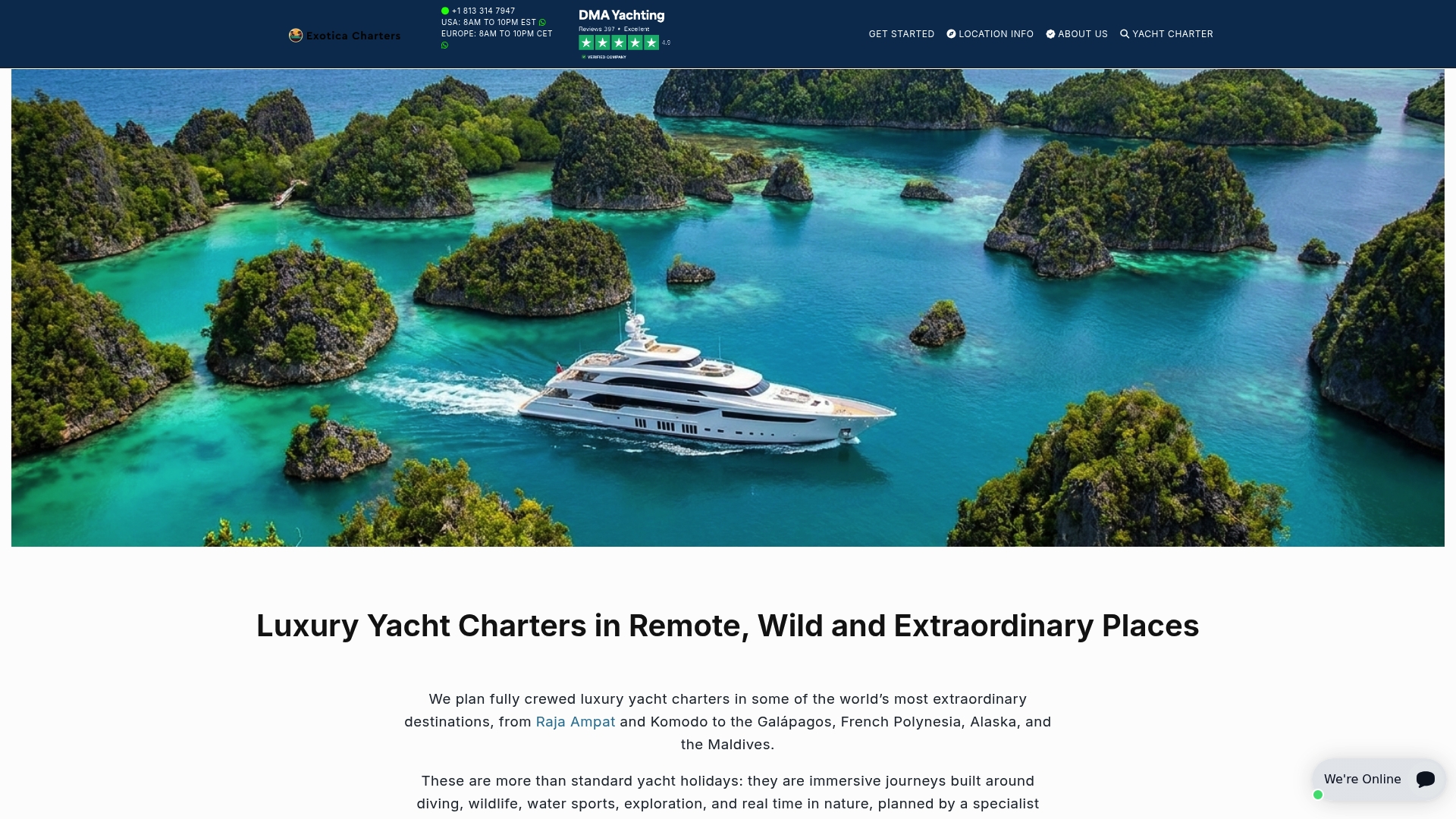
We plan fully crewed charters to remote and extraordinary destinations, including the Galápagos, French Polynesia and Alaska, with a focus on diving, wildlife and adventure on the water. Our fleet of options spans motor yachts, luxury yachts, sailboats, catamarans and expedition vessels, and each trip is shaped around the people aboard.
Browse the remote luxury yacht charters on our home page, explore our motor yachts or luxury yachts, or tell us what you have in mind and speak to a yacht charter specialist about dates, destinations and the right vessel.
FAQ
Can I book a luxury yacht charter entirely online?
You can search, shortlist and request a proposal online, and many brokers let you sign and pay electronically. For a crewed charter, though, you should still confirm the itinerary, contract terms and deposit protection with a person before paying. Day-boat rentals are the exception and are often completed at checkout.
How much should I budget on top of the charter fee?
Condé Nast Traveler recommends adding about 30% for food, fuel, dockage and other extras through the APA, and Robb Report's superyacht example shows 30 to 50% once gratuities are counted. Your proposal should say what is included, and a specialist can estimate extras for your route.
Is my deposit safe when I book online?
Ask who holds the money, in what type of account and what happens if the company or the yacht cannot perform. Make sure the answer is written into the contract. Travel insurance adds a further layer for cancellations and interruptions.
When should I book a crewed yacht?
Popular yachts and peak seasons fill well ahead, so earlier inquiries give you more choice of yachts and dates. Remote destinations with short seasons benefit most from early planning. A specialist can tell you the typical lead time for your region.
Sources
- We Rented Boat for a Day in Miami, Business Insider
- How to Charter a Yacht: A Beginner's Guide, Condé Nast Traveler
- How to Charter a Superyacht: Everything You Need to Know, Robb Report
- Online chartering: tips for booking with online agencies, YACHT
- 46 CFR Part 175, General Provisions, GovRegs
- Hotel booking website guide for travelers